
Aftercare.
Context
What is called aftercare is not a separate phase that follows the scene. It is the scene's final movement — the part where integration begins, where the body slowly returns from where it has been, where what was experienced finds its way toward language and rest. The scene is complete within itself when this movement has run its course. This is the spirit of Wu Wei applied to the arc of a scene: not closed by decision but complete by nature, when what needed to happen has happened.
This pattern builds directly on The Scene and The Underworld Journey — the deeper the journey, the more care the return requires. It connects to Structured Agreements and Protocol Gradient in longer dynamics, where what is called aftercare marks the transition into a more relaxed register.
Core Dynamic
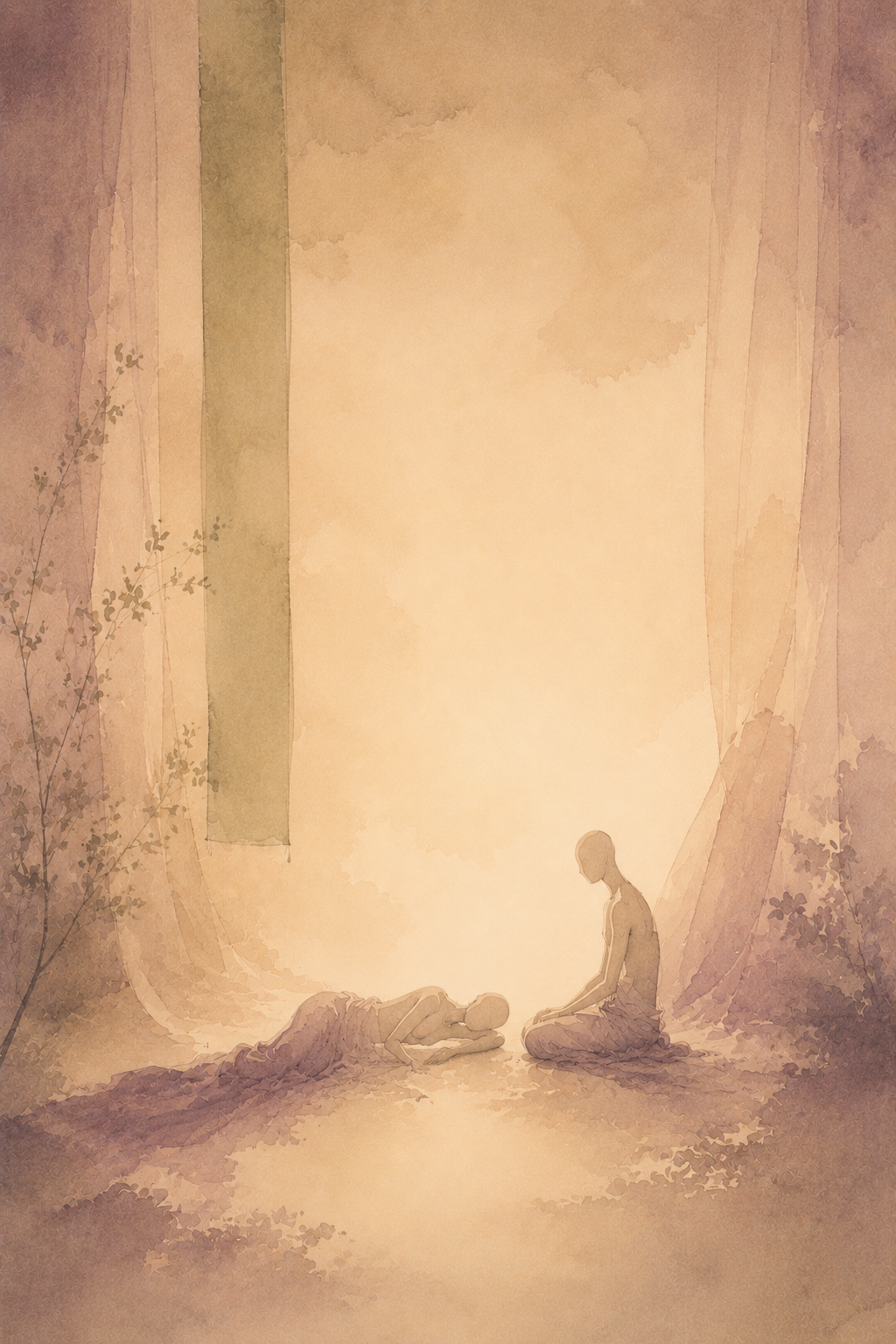
A scene — a play — is called that because that is what it is. There are roles, a story, a dynamic, and an outcome. When the scene has run its course, when both people feel complete, it opens into its final movement. This is where the integration begins. It is a great misunderstanding to view what is called aftercare as something outside the scene. It is the part of the scene where Katharsis is most likely to arrive — where what was held releases, where what was opened begins to settle. And it asks the dominant to stay fully present until the submissive has fully landed back in their body and is thinking clearly.
Care is not added at the end. It is present throughout — in how the scene is entered, how it is held, how it is followed through to its natural completion. The scene that is cared for from beginning to end does not need a separate aftercare phase. The care is already there. What changes in the final movement is the quality and form of that care — from intensity and direction to warmth and stillness.
This is part of the desired expansion — the growth that the scene was entered for. Without the full arc, the experience cannot integrate. What moved through the scene remains unprocessed, hovering between the depth it reached and the ordinary life it needs to return to. The body has been through something. The nervous system has been activated and needs time and care to return to its resting state. The mind has been in territory it does not visit in ordinary life. All of this needs tending.
The final movement is always on measure — tailored to the person and the depth of what was experienced. For some it is warmth, physical contact, silence. For others it is water, food, words. For others still it is simply the presence of the dominant nearby, without input, without agenda — just being there while the return completes itself. The dominant who knows their submissive well knows what is needed before it is asked. And the one who is working with someone new asks, designs this phase in the negotiation, and stays attentive to what the moment reveals that the negotiation did not anticipate.
Sub-drop — the hormonal and emotional dip that can follow an intense scene — does not always arrive immediately. It can come hours later, or the following day. The dominant who understands this does not consider their responsibility complete when the physical care ends. They check in. They stay reachable. In longer dynamics, this is woven into the protocol — the check-in that follows a scene is part of its completion. Dom-drop is equally real: the dominant who has held the space with full presence and full authority for the duration of a scene has also been through something. Care is for both.
This is also where The Nameless Quality is most palpable. When the scene has run by itself — when both people have dissolved into the dynamic rather than performing their roles within it — what remains in the final stillness is a state of non-duality. There is only a dominant because there is a submissive. Neither exists without the other. In that space, in the stillness after the intensity, something is present that has no name. The care that holds it without rushing past it allows the full arc to complete within itself.
Possible Pathways
Design the full arc in the negotiation — including the final movement. Ask what the submissive needs when the intensity passes: what does landing feel like for them? What helps? What makes it harder? The dominant who has this information can provide it before it needs to be asked for.
Stay present until the scene is complete within itself. Two hands on the back, then one, then none — but still there, still attending. The gradual withdrawal of physical contact as the submissive solidifies is itself a form of care. The dominant who disappears into their own decompression before the submissive has fully returned has left the arc unfinished.
In longer dynamics: build the transition into the protocol gradient. What register does the dynamic enter when the scene is complete? What signals that shift? The debrief — the conversation about what happened — belongs to a later moment, when both people are fully back and can think clearly. The final movement is for integration, healing, and rest. That is enough.
Discussion
The philosophical point of the tagline is worth sitting with. Foreplay and aftercare are categories we invented to describe parts of something that is actually continuous. The scene that is truly cared for from beginning to end does not have a separate aftercare phase — it has a quality of care that changes form as the scene moves through its arc. The naming of phases is useful for design and communication. But when the phases are treated as separate things rather than as movements within a whole, the continuity of care is broken. Wu Wei: the scene complete within itself, not closed by a decision but by a natural fullness.
The sadist and the masochist
In scenes that involve impact play or pain and pleasure journeys — where the dynamic between the service sadist and the masochist is the primary content — the final movement carries a specific quality. The body has been through intensity that the nervous system will process over time. The hormonal landscape produced by pain and pleasure is rich and complex. The landing from this state can be slower, deeper, and more disorienting than the landing from other kinds of scenes. The dominant who has given pain consciously, for the submissive's journey, holds the landing with the same care they brought to the intensity.
The shadow in the landing
The pleasing reflex shows up in the final movement with particular frequency and particular danger. The submissive who is still deep in subspace, still flooded with hormones, still far from ordinary consciousness — that person is also the most susceptible to the old voices that say they are taking up too much space, that the dominant wants to move on, that others need attention. These voices arrive precisely when the sub is least equipped to recognise them as shadow rather than as truth. The dominant who understands this stays present past the moment when it seems like presence is still needed.
I stayed present with them — first two hands on their back, then one, then none — letting them be in their own energy without providing input anymore. All I did was be with them. And then, all of a sudden, they sat up straight and started gathering their things as if to get up and leave. I slowed them down and asked what had come into them. A thought had entered their mind and whispered in their ear that they were taking up too much of my time, that I probably wanted to move on, that others probably wanted my attention. Their eyes were wide open — clearly they were still deeply under the influence of everything their body had produced throughout our journey. I reassured them that all was fine, that they could allow themselves more time, that they needed more time and that that was completely all right. They went back to lying down and stayed there for at least fifteen more minutes.
After five minutes or so, when I started feeling them solidify, I told them I would move a little further away — to sit with the facilitators of the space — but that I would keep my eye on them and that they could take as much time as they needed. And after that they came and sat with me, and it was clear that they had fully landed back in their body and mind.
Connected Patterns
This pattern completes The Scene — it is the scene's final movement, not its aftermath. It connects to The Underworld Journey — the return requires as much care as the descent. It speaks to Katharsis, which is most likely to arrive here. It connects to Daily Consent Basics and Consent Theory and Philosophy — care throughout is ongoing consent in its most embodied form. It speaks to Meeting the Shadow — the pleasing reflex surfaces here with particular force. It connects to Protocol Gradient and Structured Agreements in longer dynamics. It carries the spirit of Wu Wei — the scene complete within itself, not closed by decision but by natural fullness. It leads toward Forgiveness and Repair when something in the scene needs to be addressed later. And it is one of the places where The Nameless Quality lingers longest — in the stillness after the intensity, when both people are simply present in what has passed through them.