
Toys and Tools.
Context
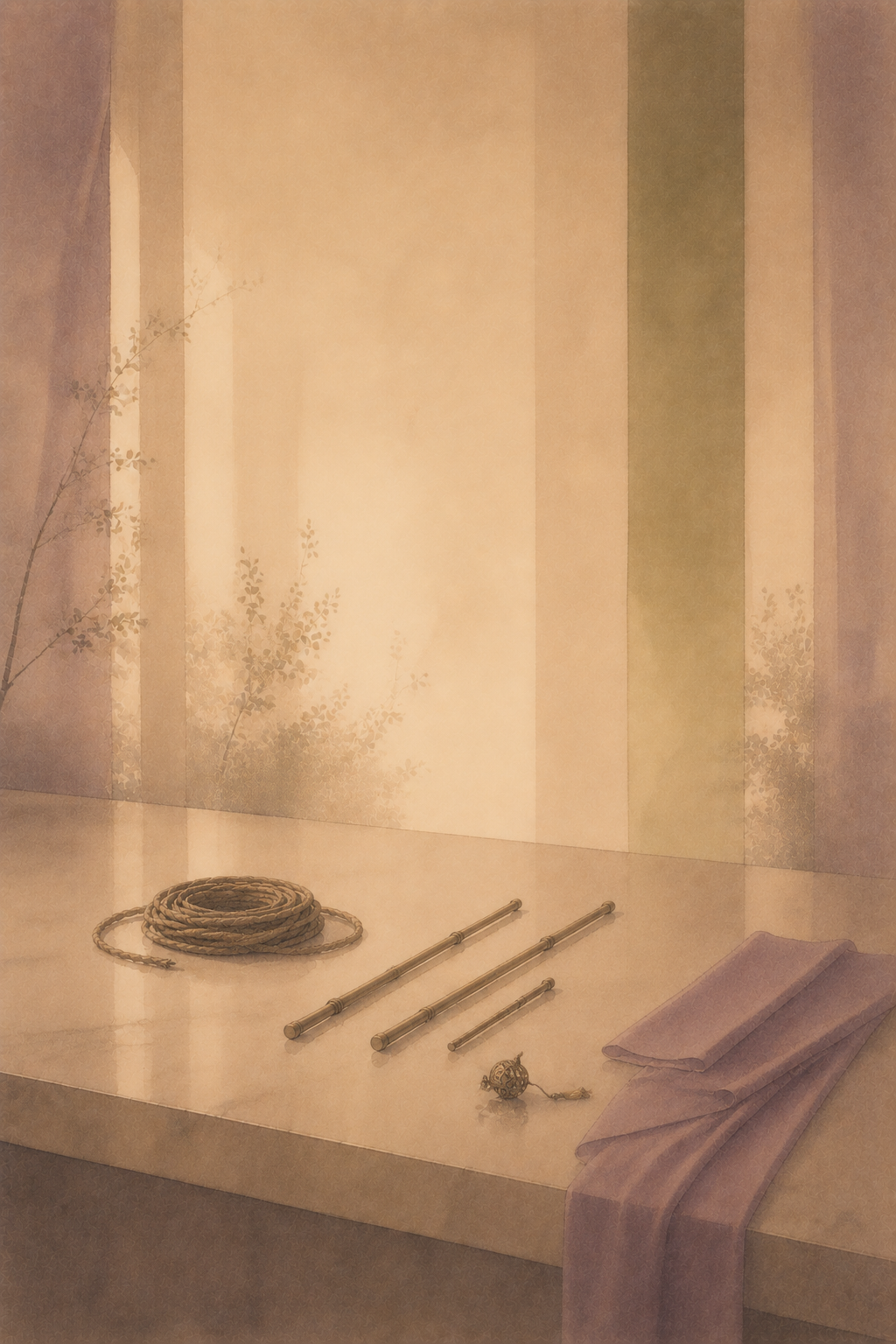
This pattern addresses the physical instruments of a scene — the objects that are brought into the dynamic to create, deepen, direct, or mark an experience. A flogger, a candle, a blindfold, a leash, a mask, a riding crop, a piece of rope — each carries its own answers to questions perhaps unasked, its own effect on the nervous system, its own symbolic weight. Tools are not decoration. They are the hands of the dynamic, extended into the physical world.
This pattern connects to Sensory Experience — tools are the instruments through which sensation is created and directed — and to Negotiations and Safe Words, which are the consent architecture around their use.
Core Dynamic
Ollivander understood something that applies far beyond wandmaking: the object and the person find each other. The dominant who picks up a particular instrument and feels something settle in their hand — who discovers that this tool speaks in a way that others do not — has been chosen as much as they have chosen. The submissive who responds to a particular object with a quality of attention that other objects do not produce — is being read by that object as much as reading it. Tools are always the way to something. And sometimes they show the way before the person has decided where they are going.
One of the most important distinctions in the use of tools is the difference between instruments of pleasure and instruments of correction. These must remain separate. The flogger used for a pleasure and pain journey carries a specific energetic charge — it is associated in the submissive's nervous system with a particular quality of experience. Using that same tool for correction or punishment introduces a confusion that the system cannot easily resolve. What was a doorway becomes ambiguous. Dedicated tools for correction, if correction is part of the dynamic, must be separate from tools of pleasure. This is not bureaucracy. It is care for the integrity of the submissive's experience.
Tools are the way to something, and that something is often Katharsis — the release of what has been held. But katharsis for its own sake, sought through the repeated use of tools without awareness of what is being processed, risks recreating familiar traumatic patterns that feel comfortable precisely because they are known. The body mistakes familiarity for healing. Awareness of this distinction — between genuine processing and the compulsive repetition of what is already known — is part of the responsibility of both dominant and submissive.
The Collar, as a tool, belongs to this pattern — the most symbolically loaded object in the dynamic, the one whose placement and removal are themselves ceremonies. Dominance can be claimed through an object — the riding crop held without being used, the leash held lightly, the Master's* favourite cane resting in sight — in the same way that Surrender can be deepened by what is placed on or around the body.
The care given to tools after a scene is itself a practice. The cleaning, the careful storage, the attention brought to the objects that have been through something — this is Sacredness expressed toward the material world. The Master's favourite cane is not just a stick. It carries history, intention, and the memory of what it has been part of. Things that Matter includes the objects through which what matters has been expressed.
Possible Pathways
Know your tools before you use them. Each instrument has its own safety profile, its own learning curve, its own effect on the nervous system. A flogger asks different knowledge than a cane. A blindfold asks different attention than rope bondage. The dominant who picks up a tool they do not understand is not exploring — they are gambling with someone else's safety.
Negotiate the tools explicitly. Which are welcome, which are not, which are new territory that requires more careful attention. Name them in the negotiation and give the submissive the opportunity to respond to each one. A tool the dominant loves and the submissive has ambivalence about deserves a conversation, not an assumption.
Care for the tools after the scene. Clean them, store them with attention, hold them as the objects they are — instruments of something significant. The tool laid carelessly on the floor after use has already lost something. The one cleaned and put away deliberately has completed the arc of the scene along with everything else.
Discussion
The laying out of tools before a scene is itself a ceremonial act. The dominant who selects what they will bring, arranges it with care, and enters the scene space with their instruments already placed — is already in the dynamic. The submissive who sees what has been prepared, who takes in the objects and what they imply — is already in the dynamic. The tools begin their work before they are used.
The mask as tool of ego-deconstruction
Among the most interesting tools in the language are those that change who the wearer is, rather than what they feel. The mask, the hood, the costume — these are identity instruments. They give the wearer permission to stop being themselves — to step out of their ordinary identity and into a role, a state, a way of being that is not available to them as their everyday self. The collar does this too, in its own way. But the mask does it more completely, more suddenly, with less transition required. The world becomes smaller, the focus narrows, the persona dissolves.
Attending to the tools
Attending applies to the objects as much as to the people. The dominant who is genuinely present to the effect of each tool — who tracks what it is producing in the submissive's body and adjusts accordingly — is using the tool in the spirit of this pattern. Tools are always in service of the person. The moment the person is in service of the tool, something has inverted.
The solution was a dog mask. He put on a blueish neoprene helmet with a snout and floppy ears, and she picked up a short riding crop. They played puppy training — he sat, rolled over, played dead, she led him by the leash. It worked immediately. The mask made his world small and helped him focus only on her. It gave him permission to drop his guard — this was a puppy, not him, and a puppy does not need to be defended. She could stay in her power because she was training a puppy, not navigating the face of her beloved. The ice melted. He opened his heart in radiant surrender. She opened hers in radiant dominance.
Two simple objects. One short riding crop. One dog mask. Everything that words and good intentions had failed to produce, they made possible in minutes.
This story is shared with the full consent of the people involved. It took place at a retreat of Consensual.
Connected Patterns
This pattern connects to Sensory Experience — tools are the primary instruments of sensation in a scene. It connects to Negotiations and Safe Words — tools must be negotiated and their use held within consent. It speaks to The Collar as the most symbolically loaded tool in this pattern. It connects to Sacredness and Things that Matter — the care of tools before and after a scene is a ceremonial act. It connects to Attending — the dominant who tracks the effect of each tool is the one using it well. It speaks to Katharsis — tools are often the path toward release — and to Punishment and Correction, where the distinction between pleasure tools and correction tools is essential. It connects to Life as a Ceremony — the laying out and putting away of tools is itself ceremony. And it connects to Jungian Archetypes — objects carry archetypal weight, and the mask that allows someone to stop being themselves is one of the most direct instruments of ego-deconstruction in this language.
* Master is an example, not a prescription. The title used in any given dynamic is whatever has been agreed upon. For more on language, gender, and inclusivity in this work, see On Inclusivity.
"It's the wand that chooses the wizard." — Ollivander, Harry Potter and the Philosopher's Stone, J.K. Rowling. © Warner Bros. Alle rechten voorbehouden.