
Sacredness.
Something makes boredom and hurt disappear.
Someone fills the cup in front of us:
We taste only sacredness.
Context
Sacredness is a quality to be found — an attunement that enhances one's attitude. Where Life as a Ceremony brings the general attitude from which to Be, Sacredness is what may be found in every object, every act, every moment of stillness, if we are willing to see it as such. The two are closely related but differ greatly in their nuance.
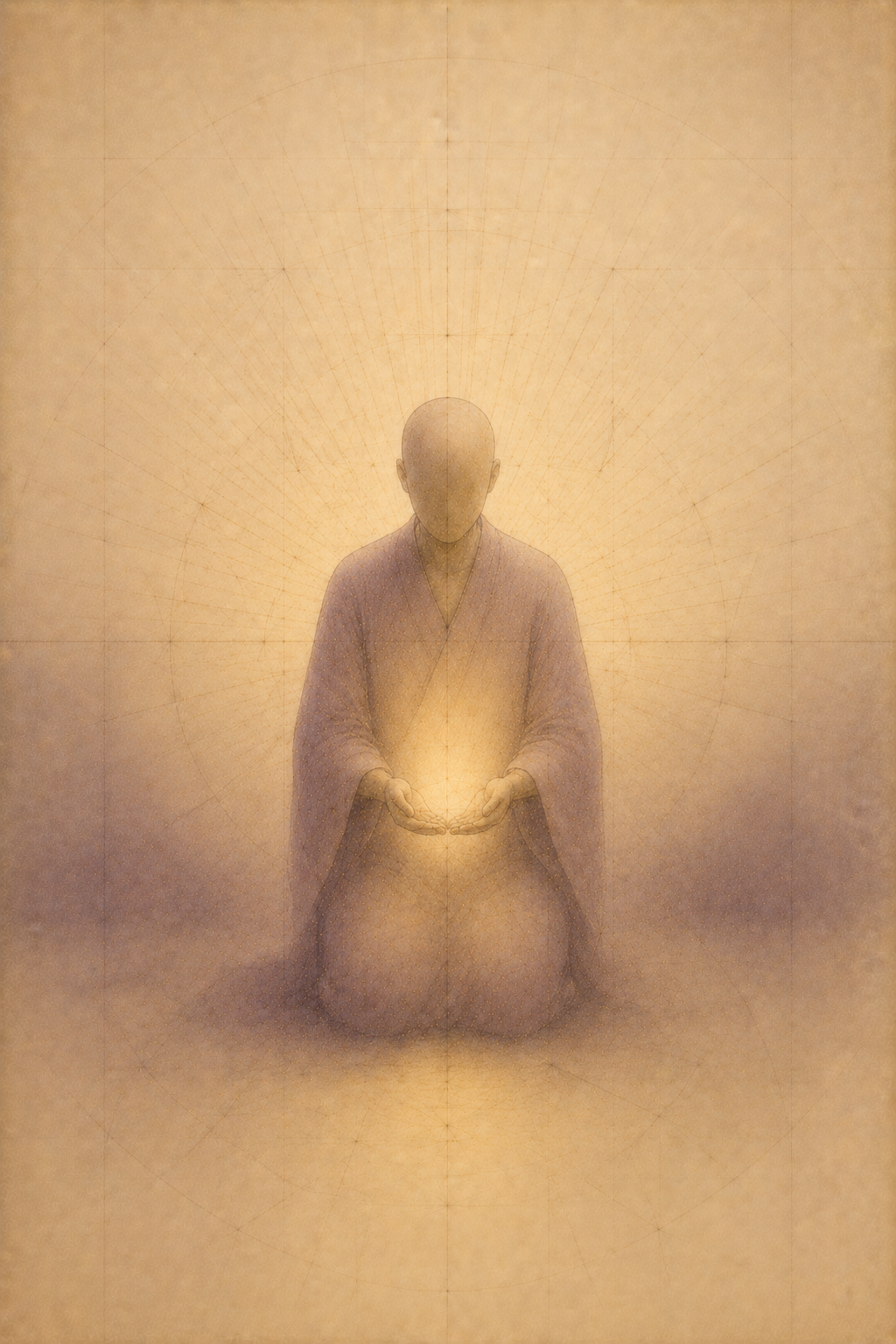
Sacredness is a quality of experience — the felt sense that what is happening here matters in a way that exceeds the practical, whether that is in a dynamic between two people, or when one is by oneself attending to their tasks and chores, or quietly Being in the prescribed pose, in Golden Silence. Whatever is occurring, there is a deliberate way of treating it with sacredness. Like Siddhartha finding enlightenment under the Bodhi tree — when all fell away and sacredness was there, as the mother of ten thousand things and as the ten thousand things simultaneously — sacredness cannot be offered or installed. There is no way to it. It is the way.
Core Dynamic
Sacredness does not begin with the dramatic moments. It begins in the ordinary ones — the morning ritual observed with genuine devotion, the small act of service offered not because it was required but because it is the natural expression of who this person is in this relationship. Sacredness is discovered in those moments. It is not produced by them. The difference is everything.
Dan and Dawn Williams describe the M/s relationship at its fullest as something that cannot be reduced to its agreements or its protocols — something that, when it is working as it can work, carries a quality of devotion that transforms the ordinary acts of the household into something closer to prayer than to housekeeping. Rubel's protocol tradition points toward the same territory from the other direction: when protocols are designed with enough precision and held with enough consistency, they create the conditions in which the submissive's service becomes genuinely devotional — not as performance but as orientation. Fegatofi names it from the inside: the contract, when it truly reflects who both people are and what they are building, is not a legal document but a vow.
Sacredness is a way to stillness. And as such it touches upon the philosophical patterns. Sprezzatura will display and honour the intervals between the actions. In Sacredness, these intervals are not mere breaks between doings but genuine parts of the doing as a whole. The collar is not sacred in itself — a piece of leather or metal has no inherent holiness. What makes it sacred is the context in which it is placed: the negotiation that preceded it, the ceremony that marked it, the relationship it symbolises, the intention of the person who placed it and the person who receives it. Sacredness is always conferred by context, by presence, by the quality of what surrounds the object or moment.
If any pattern comes close to naming what The Nameless Quality actually feels like from the inside, it is this one. Sacredness is The Nameless Quality made palpable.
Possible Pathways
Notice what already carries sacredness in your dynamic — not what you think should be sacred, but what actually is. Where do you feel the quality of genuine reverence? In which moments, which acts, which objects? Start there. Those are the things to tend.
Build the conditions that allow sacredness to emerge. This means: honest negotiations, clear agreements, protocols that fit — not as ends in themselves but as the ground from which something deeper becomes possible.
Protect what is sacred — not defensively, but with the same care that was brought to creating it. A moment of genuine sacredness that is met with carelessness is damaged in a way that takes time to repair. This is not about perfectionism. It is about recognising that what is genuinely holy deserves to be treated as such.
Discussion
The Tantric understanding
The Tantric tradition has a specific understanding of sacredness that is useful here: the sacred is not elsewhere. It is not in a temple or a text or a special state of consciousness available only to the initiated. It is here, in this body, in this act, in this moment — when this moment is met with the quality of presence that allows it to be fully what it is. The practitioner who brings this quality to the act of service is not doing something religious. They are doing something fully human — which, at sufficient depth, turns out to be the same thing.
The Jungian dimension
Douglas Thomas's work on the deep psychology of BDSM points toward what this pattern names from a different direction: when the roles in a D/s dynamic are genuinely inhabited — when the dominant is truly in their dominant nature and the submissive is truly in their submissive nature — what moves through the dynamic is not only personal. It is archetypal. The quality of devotion that the submissive brings, and the quality of authority that the dominant embodies, are expressions of forces older and larger than either person. Sacredness is what it feels like when those forces are genuinely present. This is why the experience can be so overwhelming — and why it demands to be held with such care.
Radiant sacredness
When sacredness is not reserved for special moments but woven into the texture of ordinary life — when it is present in the morning ritual, the way the day begins and ends — it begins to accumulate. And at a certain depth of accumulation, it begins to radiate. The person who lives from this orientation carries it in how they move, how they speak, how they are present with others. It is not performance. It cannot be performed. It is the natural emanation of a life that has been genuinely consecrated — and it is recognisable, instantly, by anyone who has ever felt it.
Connected Patterns
This pattern deepens Life as a Ceremony — ceremony is the practice, sacredness is what is present when the practice is fully alive. It builds on Negotiations and Structured Agreements — you cannot consecrate what has not first been clearly agreed upon. It expresses the deepest dimension of Dominance and Surrender — both fully inhabited, both in service to something larger than themselves. It connects to The Collar — whose sacredness is conferred entirely by the context this pattern describes. It speaks to Things that Matter — sacredness gathers around what genuinely matters — and to The Underworld Journey and Katharsis, where sacredness becomes most concentrated and most demanding. It is grounded in Tantra and Jungian Archetypes — both of which describe what is present when sacredness is fully alive. And it leads, as all things do when they are genuinely inhabited, toward The Nameless Quality.
Abū-Sa'īd Abul-Khayr (967–1049) — inscribed above the entrance to the tomb of Rumi, Konya.