
Tantra.
The Framing
This pillar is one of six that together both form the philosophical ground beneath this pattern language — and the vault that overarches the entire work. They do not lead to a destination. Each one, when genuinely practised, is itself an expression of what this language calls The Nameless Quality: the aliveness that emerges when a conscious kink dynamic is fully inhabited rather than performed. The Tantric path unfolds through the body — not around it, not despite it, but all the way through it. When the mind's management releases and sensation is met with full presence, the body becomes a gate. What opens on the other side of genuine physical surrender is not emptiness but a fullness that the body, fully inhabited, has always been pointing toward. The pattern language, deeply practised, arrives at the same place by a different route.
The Tradition
Tantra is one of the most misunderstood traditions in the Western world. Reduced in popular culture to a set of sexual techniques for prolonged pleasure, its actual scope is far larger: a vast body of Hindu and Buddhist teachings, spanning at least fifteen centuries, concerned with the use of the body, sensation, and energy as vehicles for spiritual realisation. Where many spiritual traditions treat the body as an obstacle to transcendence — something to be disciplined, denied, or transcended — Tantra takes the opposite view. The body, in all its sensation and desire, is the very instrument through which the sacred becomes accessible.
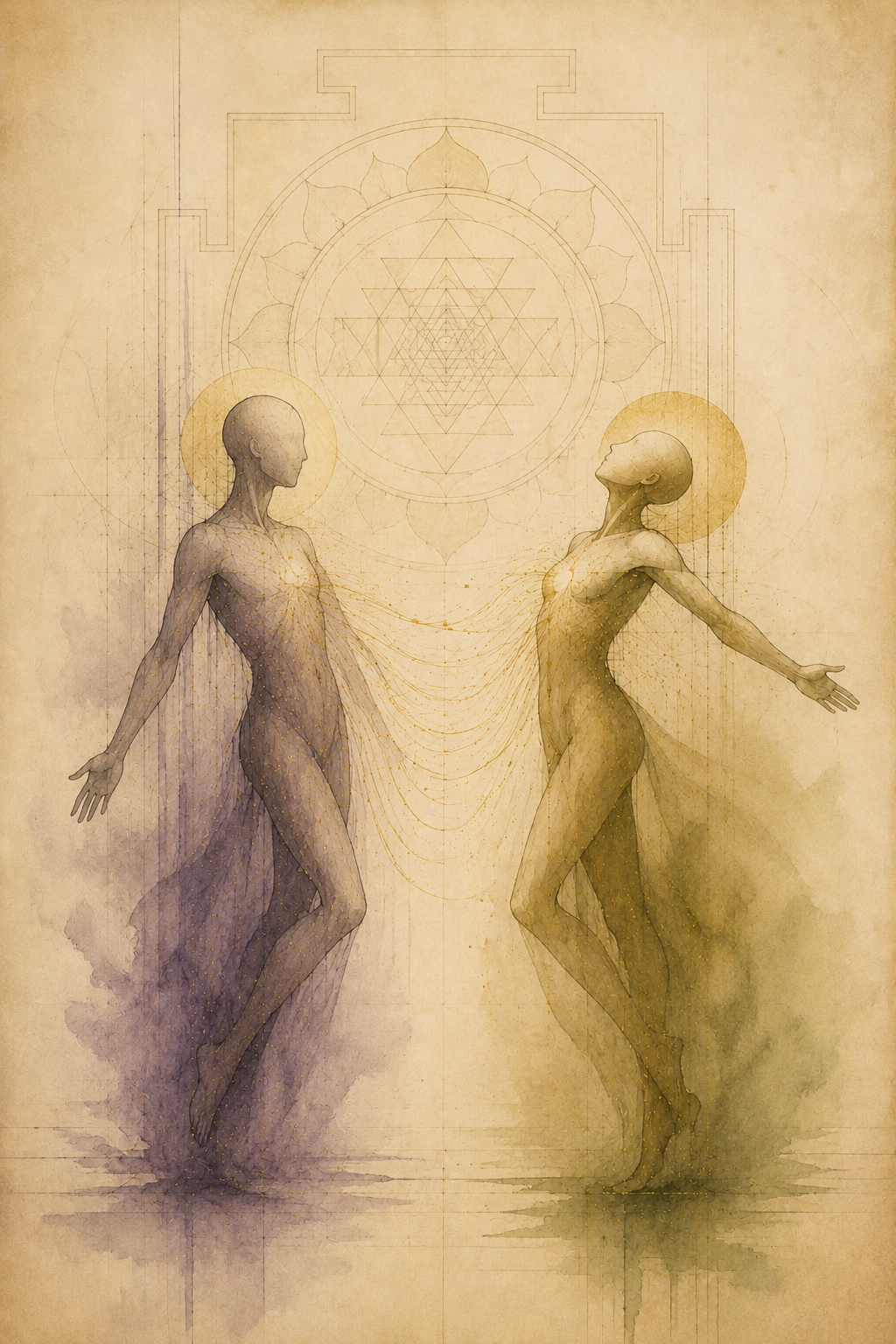
The Tantric path works with what is — with desire, with energy, with the full spectrum of embodied experience — rather than against it. Shakti, the feminine creative force, and Shiva, pure consciousness, are not opposites to be resolved but polarities whose dynamic interplay is the generative force of existence itself. The practitioner who can hold this tension consciously, without collapsing into either pole, touches something that transcends the personal.
In the Dynamic
The Shakti-Shiva polarity maps with remarkable precision onto the D/s dynamic. Shiva — pure, still, witnessing consciousness — and Shakti — dynamic, embodied, creative, surrendering — are not a hierarchy but a complementarity. Neither is complete without the other. The dominant who holds space without being moved by it, who witnesses without withdrawing, who directs the energy without consuming it — is in a Shiva orientation. The submissive who moves fully into embodied experience, who allows sensation to become energy, who surrenders into the dynamic rather than enduring it — is in a Shakti orientation. Neither is superior. Both are necessary. Together they generate something neither could access alone.
This illuminates Sensory Experience (#41) and The Underworld Journey (#42) at a deeper level than psychology alone can reach. The journey into intense sensation is not only a psychological event — it is an energetic one. The body under intense experience becomes a different kind of instrument. What moves through it in those moments is not merely adrenaline and endorphins. Harrington's Sacred Kink describes this explicitly: the scene as a vehicle for altered states, for contact with something larger than the personal self, for experiences that the rational mind cannot fully contain or explain.
Tantra also reframes On the Nature of Pain (#48) and Katharsis (#50). Pain, in the Tantric view, is not simply sensation to be endured or enjoyed. It is energy — condensed, intensified experience that, when met with full presence rather than resistance or dissociation, can move through the body and release something that was held. The dominant who understands this is not inflicting pain. They are creating the conditions for an energetic event.
The Sacredness (#23) pattern and Life as a Ceremony (#22) are both expressions of the Tantric understanding that the ordinary can become sacred when met with the right quality of attention. The collar placed with genuine intention is a ritual act. The standing order followed with full presence is a devotional practice. The scene entered with reverence is a ceremony. Tantra does not require elaborate ritual. It requires presence.
And Surrender (#06), read through Tantra, becomes something larger than personal yielding. It becomes the movement of Shakti toward Shiva — the creative force offering itself to pure consciousness, knowing that in doing so it will be transformed. This is not submission as diminishment. It is submission as participation in something vast.
Possible Pathways
Bring the quality of presence that Tantra requires into every layer of the dynamic — not only the scene, but the ordinary day. Meet sensation fully rather than managing it. Let the body be an instrument rather than an obstacle. In the scene: notice what moves through you, not only what you feel. In daily life: bring the quality of attention that makes the ordinary sacred. Study the Shakti-Shiva polarity not as metaphor but as a genuine description of the energetic reality of your roles. Ask which pole you inhabit most naturally, and what the other pole asks of you.
Discussion
The Tantric tradition's insistence on the body as path rather than obstacle is perhaps its most radical gift to conscious kink. Most of Western culture — and most of mainstream spirituality — treats the body with suspicion: as the source of distraction, of sin, of the kinds of desire that pull us away from higher things. Tantra inverts this entirely. The body, with all its desire and sensation and vulnerability, is precisely the instrument through which the deepest experiences become available. You cannot transcend the body by ignoring it. You transcend it by going all the way through.
Presence as the Tantric practice
The core Tantric practice is not technique but presence — the quality of attention that meets experience fully, without flinching, without grasping, without managing. In the context of Availability (#37) and Attending (#39), this is not passivity but a specific quality of active receptivity — the dominant who is fully present to the submissive, the submissive who is fully present to the experience. Nothing managed, nothing withheld. This is what produces the quality that both people sometimes describe afterwards as having been somewhere together that they cannot quite name.
The energetic dimension of aftercare
Tantra also reframes Aftercare (#44). If the scene is an energetic event — if what moved through the people in it was larger than the personal — then aftercare is not merely psychological comfort. It is the grounding of an energetic state, the gentle return from an expanded condition to the ordinary self. The dominant who understands this provides aftercare not as a formality but as the completion of the energetic arc that the scene opened.
Lee Harrington, Sacred Kink: The Eightfold Paths of BDSM and Beyond (Mystic Productions Press, 2009). Douglas Thomas, The Deep Psychology of BDSM and Kink (Tantor Audio, 2024).
Connected Patterns
This pillar underlies the entire Body and Presence layer — most directly Sensory Experience (#41), The Underworld Journey (#42), Availability (#37), and Attending (#39). It gives the deepest grounding to Dominance (#05) and Surrender (#06) as a polarity that is energetic and generative, not merely relational. In Practice it connects to The Scene (#43), Aftercare (#44), On the Nature of Pain (#48), and Katharsis (#50) — all of which describe moments where the body becomes a vehicle for something larger than the personal. In Protocol it speaks to Sacredness (#23) and Life as a Ceremony (#22) — the Tantric understanding that the ordinary becomes sacred through the quality of attention brought to it. And it leads, with all the other pillars, toward The Nameless Quality (70+1) — which is what Tantra has always been moving toward.