
The Nameless Quality.
The Framing
This is one of six philosophical pillars that together both form the ground beneath this pattern language — and the vault that overarches the entire work. The other five — Jungian Archetypes, Sprezzatura, Wu Wei, Tantra, Omakaze — are each a different face of the same quality: the aliveness that emerges when a conscious kink dynamic is fully inhabited rather than performed. None of them leads here as a destination. Each of them, genuinely practised, already is here. And the pattern language itself — the seventy patterns, worked with seriously, lived rather than read — arrives at this same place by yet another route. The Nameless Quality is not the reward at the end of the work. It is what the work, at its best, turns out to be, always.
Context
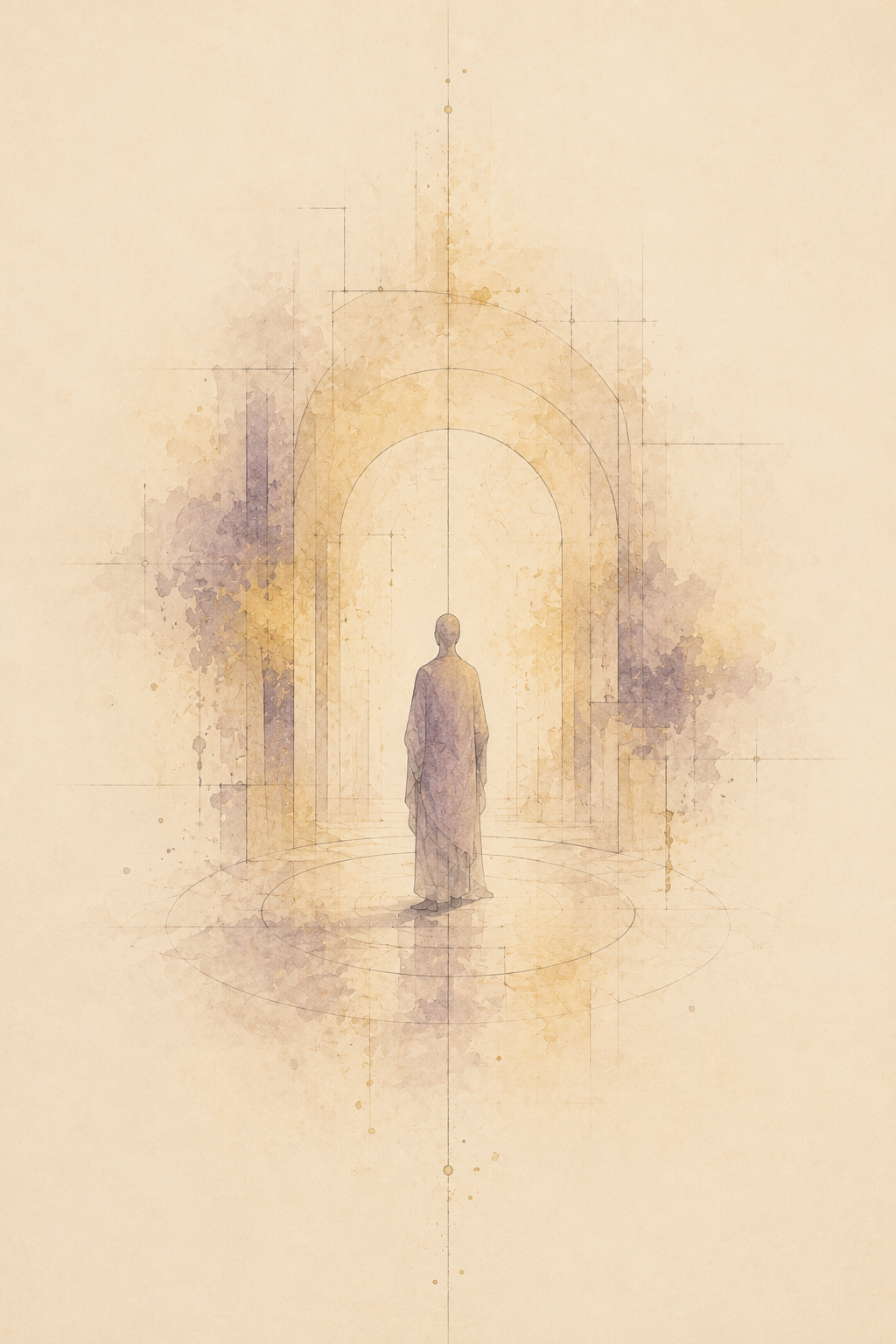
Christopher Alexander spent his life trying to name what made certain buildings — certain rooms, certain towns, certain thresholds — feel undeniably alive, while others, built to specification, remained dead on arrival. He called it the Quality Without a Name. Not beauty, not function, not harmony — though it includes all of these. Something prior to those words. Something you recognise the moment it is present, and feel the absence of the moment it is not.
This is the last pattern and the first. It is numbered 70+1 because it sits outside the sequence — not as a conclusion, but as the reason the sequence exists. The 70 patterns are not a path to this quality. They are the conditions under which it might emerge.
Core Dynamic
A consciously designed relationship can be technically correct and spiritually inert. The contract is in order. The negotiations were thorough. The protocols are followed. And yet something is missing — the quality of aliveness, of genuine meeting, of two people actually present to what they have built together. The language can be spoken without being inhabited. The patterns can be followed without the thing they are pointing toward ever arriving.
This is not a failure of the patterns. It is the nature of the quality they are pointing toward. The Nameless Quality cannot be produced directly. It is not an achievement. It is more like weather — it arrives when the conditions are right, and no amount of will can manufacture it when they are not.
What the patterns can do is clear the ground. Remove the obstacles. Create the conditions of space, honesty, safety, presence, and trust in which something larger than the sum of the agreements might occasionally visit.
When it does, both people know it. Not because it was planned, but precisely because it wasn't. The relationship becomes, in those moments, more than what either person brought to it. That is the quality. That is what this entire language is for.
Possible Pathways
Stop trying to produce it. Build the conditions — the consent, the honesty, the structure, the care, the willingness to be genuinely seen — and then release the outcome. Notice when it arrives. Do not grasp at it. Learn from the moments it was present what you had done differently, not so you can repeat it mechanically, but so you understand more deeply what your relationship is capable of when everything is in place.
Discussion
The six philosophical pillars that underlie this language — Sprezzatura, Wu Wei, Tantra, Jungian Archetypes, Omakaze, and the Nameless Quality itself — are all, from different angles, pointing at the same thing. They are not synonyms. They are six traditions that have each, independently, arrived at a description of the same territory.
Sprezzatura, the Renaissance ideal of effortless mastery, describes what dominance looks like when it has been fully internalised — not performed, not effortful, simply present. Wu Wei, the Taoist principle of action that does not force, describes the quality of surrender when it comes from wholeness rather than wound — and the quality of leadership that does not push but flows. Tantra treats the body and the other as a living gateway to something that cannot be reached through the mind alone. The Jungian archetypes name the deeper forces moving through the roles — the shadow beneath the Dom, the anima beneath the sub, the Self that both are reaching toward. Omakase — the complete trust placed in the one who knows what is needed, the total release of the menu — describes the quality of surrender that this work, at its best, makes possible.
Each of these is a path. None of them is the destination. The Nameless Quality is the destination — or rather, it is what you find when you stop looking for a destination and begin simply inhabiting the practice.
The sum that exceeds its parts
Alexander's insight was architectural: when enough of the right patterns are present in a building, something emerges that none of the individual patterns could produce alone. The same is true here. A relationship that has worked carefully through enough of these patterns — not all of them, not perfectly, but genuinely — becomes capable of moments that neither person could have generated individually. The dynamic becomes, briefly, a third thing. Something that lives between the two people rather than in either of them.
This is not mysticism. It is the ordinary miracle of genuine human contact, made more likely — though never guaranteed — by everything this language has been building toward.
Connected Patterns
This pattern connects to everything and to nothing in particular. If there is a beginning that mirrors it most directly, it is Why Would You (#01) — because the quality, when it arrives, is the answer to that question. It connects to The Underworld Journey (#42), where the body and the surrender go deepest. To Katharsis (#50), where something is released that could not have been planned. To Growing Wholeness (#64), which describes the long arc of which this quality is the occasional, ungovernable fruit. And to the six philosophical pillars — Sprezzatura, Wu Wei, Tantra, Jungian Archetypes, Omakaze — each of which is a different name for the same direction of travel.