
Omakaze.
The Framing
This pillar is one of six that together both form the philosophical ground beneath this pattern language — and the vault that overarches the entire work. They do not lead to a destination. Each one, when genuinely practised, is itself an expression of what this language calls The Nameless Quality: the aliveness that emerges when a conscious kink dynamic is fully inhabited rather than performed. Omakaze is revealed, unseen but felt, through trust in what is larger than the self — through the release of control and expectation, the choice to place oneself in the care of something wiser than one's own agenda. When that trust is genuine and that care is real, something arrives that could not have been planned or produced. It is not a reward for surrender. It is what surrender, fully enacted, turns out to be. The pattern language, deeply practised, arrives at the same place by a different route.
The Tradition
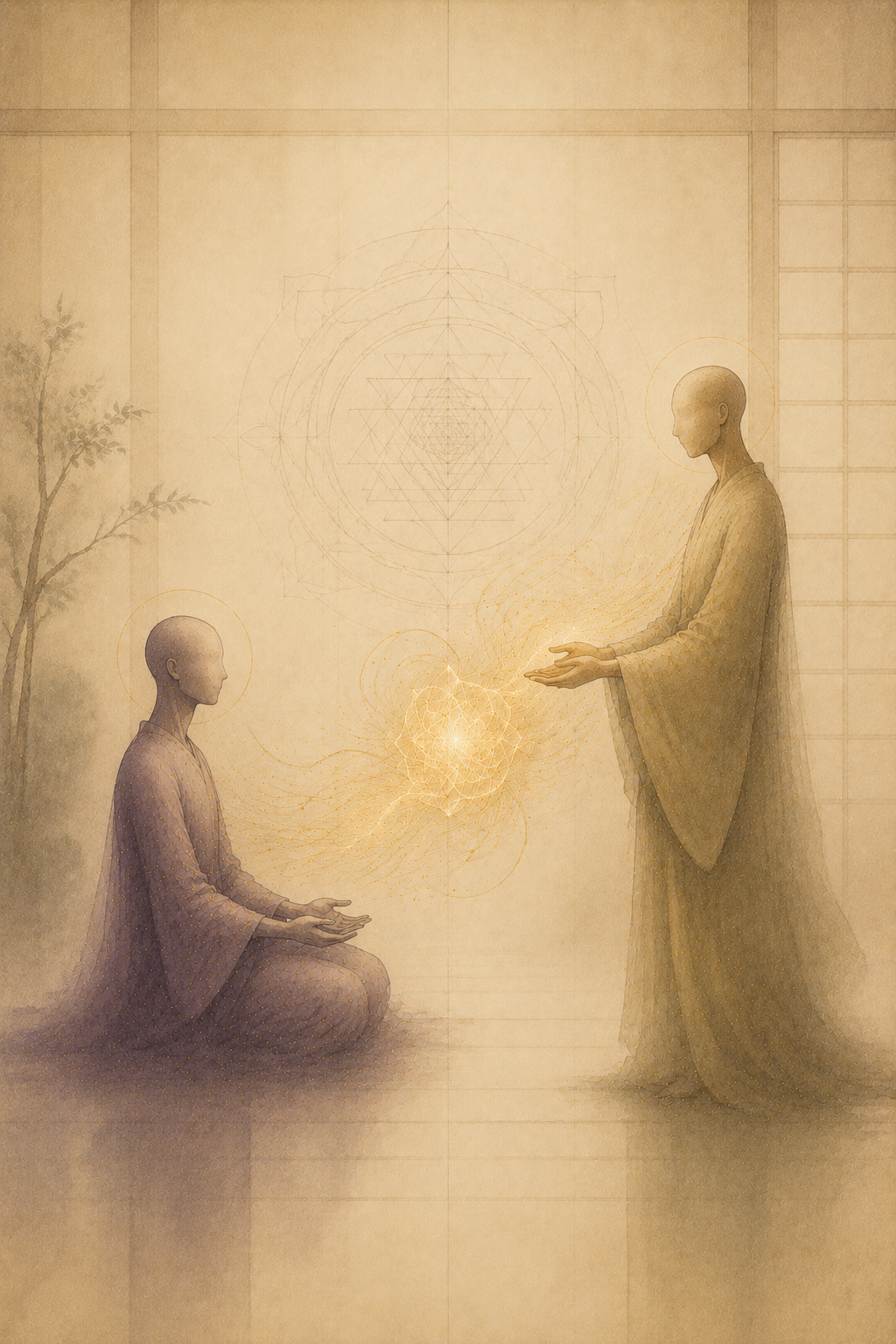
Omakase — from the Japanese omakaseru, to entrust — is the practice of placing your meal entirely in the hands of the chef. There is no menu. You do not order. You arrive, you sit, and you receive what the chef has prepared for you based on what is freshest, what is finest, what they judge to be exactly right for this moment. The chef knows things you do not know. They see the whole. You see only your hunger and your preference. The agreement is this: you trust their knowledge more than your preference, and in doing so you open yourself to an experience you could not have designed from within your own limitations.
This is not passivity. The guest who sits at an omakase table brings full presence, full receptivity, genuine appreciation. They are not absent from the experience. They have simply released the part of themselves that insists on being in control of it. That release is the gift they bring. Without it, the chef's mastery has nothing to land in.
In the Dynamic
Omakaze is the philosophical heart of conscious surrender. Read Surrender (#06) through this lens: the submissive who truly surrenders is not merely complying with instructions. They are placing themselves — their experience, their unfolding, their evening — in the hands of the dominant, trusting that what arrives will be what is needed. Not what was asked for. Not what was expected. What is needed. This requires a quality of trust that cannot be faked and cannot be rushed. It is earned, slowly, through exactly the patterns this language describes.
And it places a specific responsibility on the dominant. The chef at an omakase table is not free to serve whatever they feel like. They are in service to the guest's experience — reading them, sensing what they can receive, adjusting in real time. Dominance (#05) in the omakaze sense is not the freedom to impose. It is the responsibility to know — to read the person in front of you well enough that what you offer them is genuinely right. The dominant who takes this seriously is studying their submissive the way a great chef studies their ingredients: with attention, with respect, with the knowledge that mastery is in service to the experience, not above it.
This pillar reframes Needs (#09) and Wants (#10) in a particular way. The submissive who has named their needs and wants has not handed the dominant a shopping list. They have given the dominant the ingredients — the raw information about who they are and what they carry. What the dominant does with that information is their art. The omakaze agreement is: I give you what I know of myself, and I trust you to know what to do with it better than I do.
The Scene (#43) is omakaze made concrete. The submissive who arrives at a scene having genuinely released their agenda — who is not managing the experience toward a preferred outcome — receives something qualitatively different from the one who is internally directing from below. The dominant who reads the scene rather than executing a plan produces something qualitatively different from the one who is running a script. Omakaze requires both: the surrender of the guest, and the mastery of the chef.
And in the long arc of the relationship — in The Periodic Review (#62), in Growth, Power, Potential (#20) — omakaze names the orientation of a submissive who has stopped trying to manage their own development and has genuinely entrusted it to the dynamic and the dominant within it. This is the deepest form of surrender: not in a single scene, but across a life.
Possible Pathways
For the submissive: notice where you are still ordering from the menu — where you are managing the experience toward a preferred outcome, directing from below, holding back the part of yourself that does not yet trust. Ask what it would take to release that. For the dominant: take seriously the responsibility that omakaze places on you. The submissive who truly surrenders is not giving you freedom to do as you wish. They are giving you the highest form of trust. Study them. Know them. Earn it. And for both: build the conditions — through the patterns of trust, honesty, protection, and care — in which this quality of surrender becomes possible at all.
Discussion
Omakaze is the pillar that most directly names what the entire Structure layer is building toward. The contracts, the negotiations, the needs, the wants, the non-negotiables, the standing orders — all of this work is in service to a single outcome: creating the conditions in which the submissive can genuinely release the menu. Without that structural foundation, omakaze surrender is not surrender but recklessness. With it, it becomes possible. The structure is not the destination. It is what makes the destination safe to enter.
The difference between trust and hope
Omakaze is sometimes confused with hope — the wish that the dominant will get it right, combined with an unwillingness to say what is needed. That is not omakaze. That is avoidance dressed as surrender. Genuine omakaze trust is built on evidence: on Honesty (#32) sustained over time, on Extraordinary Protection (#03) demonstrated in practice, on Consistency (#34) that has made the dominant's character legible. You do not sit down at an omakase table the first time you meet a chef. You return because you have eaten there before, and you know what they are capable of.
Omakaze and the Nameless Quality
Of all the six pillars, omakaze is perhaps the most direct path to The Nameless Quality (70+1). The quality cannot be produced by either person alone, and it cannot be aimed at directly. But it arrives, reliably, in the space created when the submissive has genuinely released the menu and the dominant has genuinely risen to meet that gift. The chef who is given full trust produces their finest work. The guest who releases their preferences receives an experience they could not have imagined. What happens between them, in that space of complete trust and complete responsibility, is the quality this whole language has been building toward.
Connected Patterns
This pillar is the philosophical destination of the entire Structure layer — The Contract (#07), Structured Agreements (#08), Needs (#09), Wants (#10), Non-Negotiables (#11) — all of which are building the foundation on which genuine surrender becomes possible. It connects to Extraordinary Protection (#03) and Honesty (#32) — because omakaze trust is built on evidence, not hope. It is the deepest expression of Surrender (#06) and the highest responsibility of Dominance (#05). In Practice it connects most directly to The Scene (#43) — where omakaze is made concrete in real time — and to Growth, Power, Potential (#20), where it describes an orientation toward the long arc of development. In Growth and Time it speaks to Growing Wholeness (#64) — the person who has genuinely entrusted their unfolding to the dynamic. And it leads, more directly than any other pillar, to The Nameless Quality (70+1) — which is what arrives when the menu has been truly released.