
Life as a Ceremony.
lives the all seeing eye.
It has never been born,
and it will never die."
Context
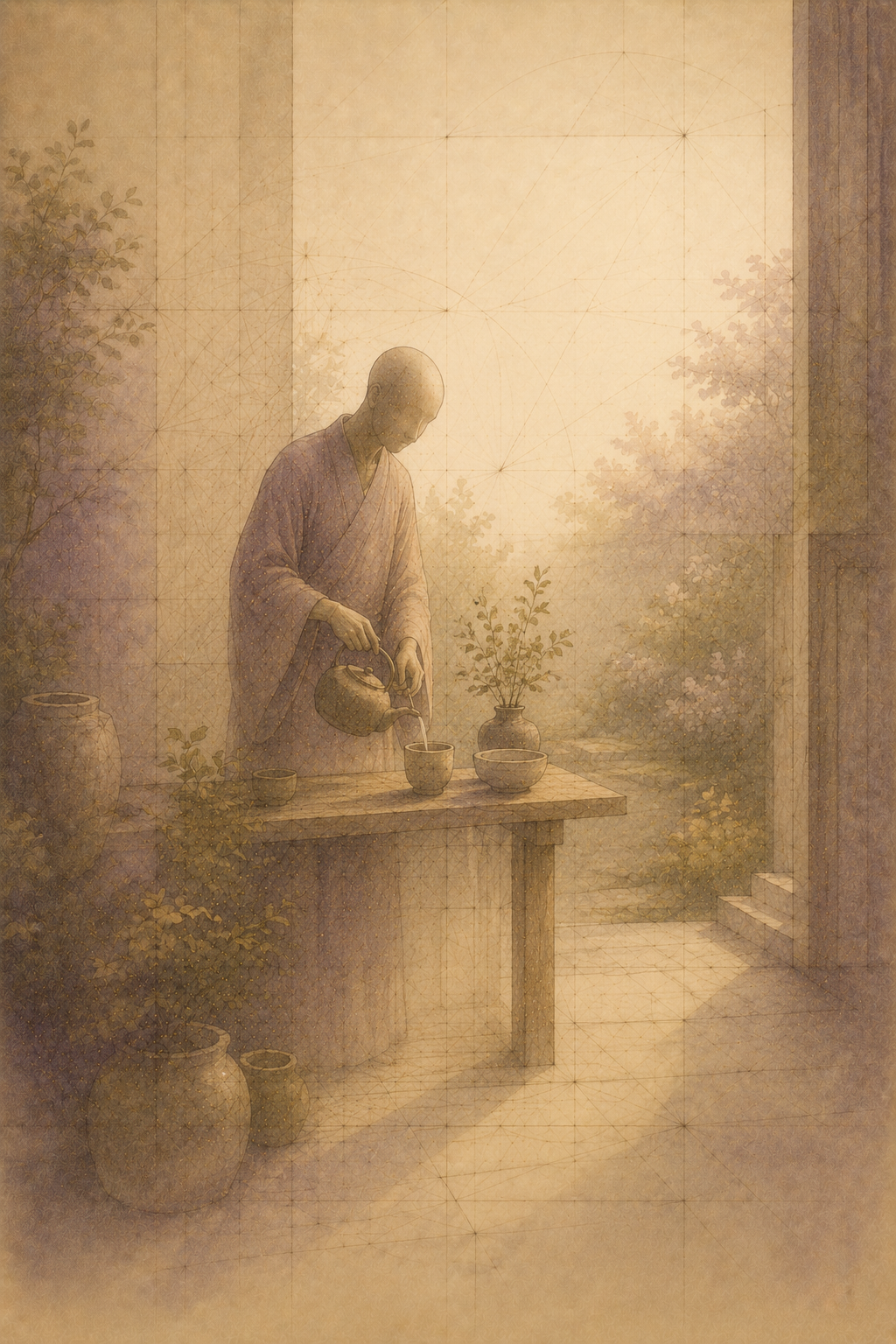
A ceremony is always intended to capture the attention of the divine and direct it towards our heart, toward our wishes or towards our desire to honor the divine, which is a desire that ultimately lives in all humans. Our wishes might be known, or unknown to us, the light of the attention of the divine bringing them to awareness. This pattern is about finding that way of being in everything; in the making of the tea, in the sweeping of the floor, in the catharsis of the scene.
It is not enough to open the heart to the divine only when sage smoke hangs thick in the room and candles burn on the altar. It is not only then sufficient to find the divine in all things when we sit in lotus pose in the tower room at full moon. It is the experience of the divine in everything that brings us to the tower room, that kindles and feeds the desire in us to learn how to to sit in lotus, that draws us to light the candles on the altar. Life as a Ceremony asks that we begin there — in the ordinary — and let the sacred find us wherever we already are.
Core Dynamic
Ceremony is not an event. It is a quality of attention. The same act — preparing tea, entering a room, beginning the day — can be performed as a routine or as a ceremony. What makes the difference is not the act itself but the quality of presence brought to it: the degree to which the person is fully there, fully intentional, fully themselves in what they are doing.
In a conscious dynamic, this quality is not reserved for the dramatic moments. It is cultivated in the small ones. The submissive who brings genuine care to the ordinary acts of service — who is fully present in them rather than merely executing them — is practising surrender in its most sustained form. The dominant who receives that care with full attention — who notices it, acknowledges it, honours it — is practising authority in its most grounded form. Neither is performing. Both are present. And presence, sustained across the texture of a life, is what ceremony actually is.
This is the connection to Sprezzatura: the ceremony that has been so deeply internalised that it no longer requires effort is the ceremony at its most complete. The practice has become the person. The form has become the expression. What remains is not discipline but grace.
And this is also the connection to Wu Wei: the ceremony that flows without forcing, that arises from the nature of the people and the relationship rather than from the effort to maintain a standard, is the one that can be sustained across years. The ceremony that requires constant conscious effort is not yet ceremony — it is rehearsal.
Possible Pathways
Choose one ordinary act in your dynamic and bring the full quality of your attention to it. Not once, as a demonstration, but consistently — until the quality of presence becomes the act's natural register. Notice what changes: in the act itself, in how it is received, in how you feel having done it that way.
Ask what matters in your dynamic — what the Things that Matter actually are — and build the ceremonies around those things. A ceremony that is built around something that genuinely matters to both people will sustain itself. One built around convention or expectation will gradually hollow out. Periodic Review is the moment to ask which ceremonies are still alive and which have become empty repetition — and to either renew them or release them with the same care with which they were created.
Discussion
Where life is not a ceremony
The more interesting question is not where life becomes ceremony but where it does not — and why. Most people move through large stretches of their day in a kind of managed absence: present enough to function, absent enough not to feel. The commute, the meal eaten while scrolling, the conversation half-attended to. The ordinary moments that could be attended to but are not. This is not laziness. It is often protection — a learned distance from experience that once felt like too much. The Shadow operates here with particular fluency: the parts of life that receive no ceremony are often the parts that carry the most unprocessed weight.
Are we worthy of it?
There is a deeper question underneath the practical one: do we allow ceremony for ourselves? Not as performance for another, not as service to a dynamic, but as a genuine act of care directed toward our own life and experience. Many people find it easier to create ceremony for others than to receive it themselves — or to allow that their own ordinary moments are worth attending to. The question "am I worthy of love?" is not abstract. It shows up in whether you make the tea for yourself with the same care as you make it for another. Whether you eat your meal as a ceremony or as a refuelling stop. Whether you allow the ordinary texture of your own life to matter. The dominant who cannot receive care graciously and the submissive who cannot allow that their service is genuinely valued are both caught in the same pattern: the inability to let love land. That inability has a history. The Shadow knows it well.
The way of the sword
The swordsman who has spent decades practising only the drawing of the blade — the single movement of iaï — has not had ceremony handed to him. He has grown into one. What began as instruction has become, through sustained attention, something that can no longer be separated from the person who performs it. The movement and the man are the same thing now. This is the direction this pattern points: not toward the deliberate creation of ritual but toward the deepening of attention until the ordinary act reveals its ceremonial nature. Sprezzatura is the name for when that depth becomes visible as ease — the apparent effortlessness of someone who has attended to something long enough that the attending has disappeared into the act itself. And Wu Wei is its philosophical ground: the action that arises from nature rather than from effort. The Nameless Quality moves through this quietly — reflected in the light of the tea that is being poured, in the stillness of the threshold crossed deliberately, in the moment when the ordinary and the sacred are no longer distinguishable from each other. The ceremony continues not because it is required but because it has become the person's natural expression of who they are in the dynamic.
though he knows nothing of any sin,
may not rest upon my soul."
John Sebastian Bach — excerpt from the 'Aus Liebe'
Connected Patterns
This pattern connects to Sacredness, which names what is present when ceremony is genuinely alive. It speaks to What Would Master Do and to Punishment and Correction, where the restoration of ceremony after a breach is itself a ceremonial act. It connects to Things that Matter — the compass that keeps ceremony oriented toward what is genuinely alive — and to Periodic Review, where ceremonies are renewed or released. It is grounded in three of the philosophical pillars: Sprezzatura, Wu Wei and Tantra — each of which describes, from a different direction, the quality of presence that makes life ceremonial.
Maneesh de Moor, Songs from the Tree of Light (2017). Johann Sebastian Bach: Matthäus-Passion, BWV 244, Aria no. 49 (Aus Liebe will mein Heiland sterben), tekst door Picander, 1727.