
Meeting the Shadow.
Context
This pattern works in close conjunction with Why Would You. That pattern opens the inquiry into motivation; this one is the ground on which that inquiry can actually be answered honestly, because much of the truest motivation lives in territory the conscious mind has never visited. A conscious dynamic is, in this sense, departure point, vehicle, and destination for this work all at once — every role within it asks the same confrontation of whoever holds it.
Core Dynamic
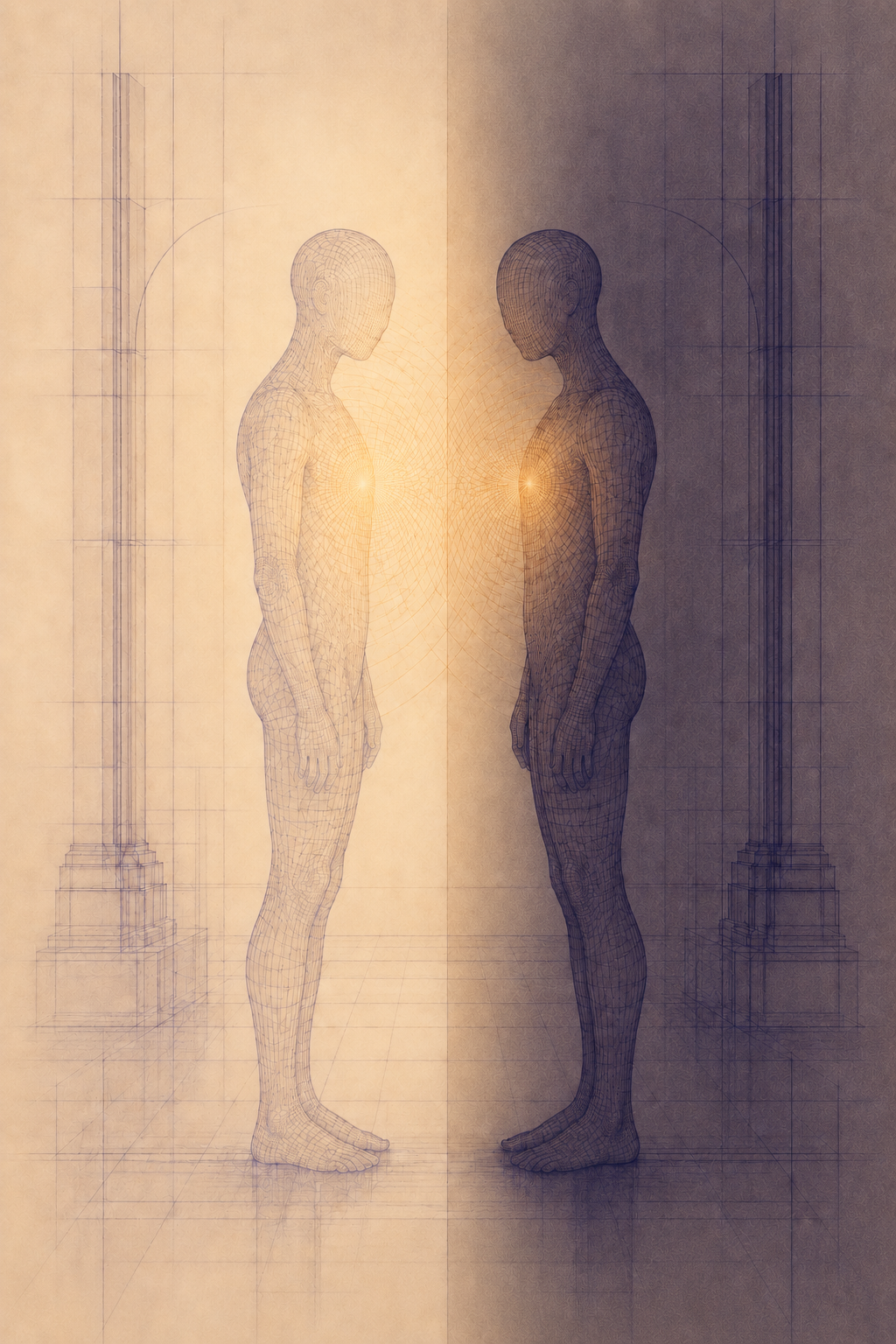
Every human being carries a shadow — the reservoir of whatever a person's family, culture, and upbringing required them to disown in order to be acceptable. Jung placed the shadow directly beneath the persona, the polished social mask everyone constructs, and described the two as locked in permanent opposition: whatever the persona displays, the shadow holds the reverse. The shadow does not vanish because it's disowned. It goes underground, and from there it exerts real pressure on behaviour — surfacing as projection, as compulsion, as the sudden, disproportionate charge a particular situation carries for no apparent reason.
Kink and power exchange sit unusually close to this territory. They involve precisely the drives most cultures suppress hardest: the desire to govern another person's body and experience, the desire to be governed, the erotic charge of pain, the ritual enactment of hierarchy, complete vulnerability offered on purpose. These aren't peripheral human experiences. They're ancient and central — which is exactly why they were forbidden so thoroughly in the first place.
Robert Johnson, building on Jung's work, made an observation that complicates the usual picture of shadow work: people resist the noble aspects of their own shadow more fiercely than they resist the dark ones. It's relatively easy to admit to occasional cruelty or impatience. Admitting that real talent, real authority, real depth has been buried alongside the cruelty — that it's been sitting there the whole time, waiting to be claimed — is, for most people, a far harder thing to face. Unexamined, this shadow runs the show regardless of which role someone holds: it shows up as unaccountable power in one direction, as collapse mistaken for surrender in the other, and as a hollowing-out of the aesthetics in anyone who never asked what they were actually seeking.
The shadow is not the enemy. It contains energy that belongs to you, including some of the most valuable energy you have. Meeting it doesn't mean eliminating it. It means recognising it as yours, which is what makes it possible to choose, consciously, what to do with it — rather than being moved by it without knowing.
Possible Pathways
Before taking up any significant role in power exchange, look at your shadow. Not to resolve or eliminate what you find, but to know it, including the parts of it that turn out to be gold rather than darkness. Map what you were taught to disown. Notice which aspects of kink carry the heaviest charge for you, and get curious rather than embarrassed about why. Bring this knowing into The Contract with you, even where it only shapes the conversation rather than appearing on the page. And find a practice — therapy, serious supervision, meditation, journalling, community — that supports the ongoing work of integration, because this is never a single pass through a door that then stays open.
Discussion
The dominant who has met their shadow knows the difference between wanting to be of service through control and wanting to exercise power over someone who cannot refuse. The submissive who has met their shadow knows the difference between offering surrender as a gift — an act of real agency and courage — and collapsing into a role because standing upright felt too dangerous to keep doing.
Specific shadow territories in kink
The shadow of shame. Many people are drawn to kink partly because it's transgressive, and the transgression itself carries charge. That's not a problem on its own — unless the charge is entirely about transgression, in which case the desire has no stable centre once the relationship normalises and the transgression stops feeling transgressive.
The shadow of power. The desire to control is widely condemned, which tends to push it deeper rather than making it disappear. Meeting this shadow means looking at the desire without flinching: yes, I want authority over this person. What kind? Why? Toward what end?
The shadow of worthlessness. Some people enter submission carrying a wound that says: I deserve to be treated as less. The scene can seem to confirm this, briefly relieving and ultimately corrosive. Meeting this shadow doesn't mean avoiding submission. It means entering it from dignity instead of from wound.
The shadow of rescue. Some dominants aren't actually drawn to power but to the role of rescuer — the one who saves the broken sub. This is its own shadow, with its own particular dynamics and its own particular damage.
The shadow of neediness. Needs, named honestly, are simply true things a person requires. But the shadow can wear a Need's clothing convincingly — a hunger for reassurance dressed up as a structural requirement, a fear of abandonment presented as a non-negotiable. The test isn't whether something feels urgent. It's whether it would still feel true after the urgency had passed.
Where the integration actually happens
Lee Harrington's writing on sacred kink treats this work as inseparable from the practice itself rather than a precondition completed once, in private, before the real thing begins. The container a dynamic builds — its daily consent practice, its consent philosophy — is what makes it safe enough to let the smaller, more frightened self come forward and be seen. Douglas Thomas pushes the same point further from a Jungian angle: the desire that draws someone into a D/s dynamic is rarely fully conscious to begin with. It carries shadow material, unprocessed history, archetypal energy the ego didn't choose and can't fully narrate. This doesn't make consent meaningless. It means the most meaningful consent isn't simply the rational mind's agreement — it's the informed participation of someone who has done enough of this work to know something real about what they're actually consenting to.
A lifelong arc, not a single passage
This integration rarely completes in one sitting, and a conscious dynamic gives it somewhere to keep happening. The same dynamic that first surfaced a piece of shadow material is often, years later, the place where that material finally settles — recognised, owned, no longer running underground. Growing Wholeness describes what that settling sounds like at scale: a cracked bell, slowly mended, ringing fully again. Each piece of shadow met and integrated here is one small repair to that resonance.
What's actually being asked for
Jung was specific about what this work demands, and it isn't analysis. "One does not become enlightened by imagining figures of light, but by making the darkness conscious." Curiosity, not courage and not cleverness, is the real working tool here. The moment you notice you can no longer stay curious about your own behaviour in a given situation, that's the shadow speaking — and that's exactly where the work is. This asks for the capacity to not know yet, to sit with a vulnerability that hasn't resolved into a tidy explanation, and for something more active than patience: deliberately, compassionately setting up situations where you can be triggered, not to suffer through them but to feed the inquiry, to watch what gets activated and practise choosing a different response than the automatic one.
What I did not expect was the resistance. My body fought it. For a few hours I developed a fever — a literal physical response to the prospect of releasing control. It ended in catharsis, a breakdown into surrender. And what it showed me was how deep the need for control actually runs in me. How much of my sense of safety lives in the idea of being in charge.
That was one side of my shadow.
The other side I meet in the dominant or facilitative position: my pleasing tendencies. The fear of rejection, the self-doubt that asks — what if I fully step into my power, even within consent? Because here is the thing: if I don't fully take the lead, the other person cannot fully let go. My hesitation becomes their ceiling.
Seeing that — really seeing it — and having clear agreements, and taking time after scenes to reflect both together and alone, has shifted something fundamental in how I move in these spaces.
Consent is what makes any of this possible at all. When the larger container is safe — when the agreements are known, when the person you're with can be trusted — you can afford to let the smaller self feel briefly unsafe inside that safety. The frame is what allows you to release the control you'd otherwise need just to feel secure.
Connected Patterns
This pattern lives within Why Would You as the ground that question's honest answers actually grow from, and connects directly to The Nature of Your Relationship and The Contract, which depend on self-knowledge this pattern produces. It opens into Extraordinary Protection, and connects to every pattern involving the assumption of a role, particularly Dominance and Surrender. It underlies Daily Consent Basics and Consent Theory and Philosophy, which name explicitly why the self-knowledge this pattern produces is what genuine consent actually requires. It connects to Forgiveness and Repair — unexamined shadow is the most common source of harm that later needs repairing — and reaches forward into Things that Matter, Wilful or Negligent Failure to Comply, and Relations with Family and Friends, all of which lean on this pattern without saying so outright. Growing Wholeness is where this integration, sustained over years, finally resonates fully — and The Nameless Quality is, in part, what becomes available once what lived in the dark has been brought into the light and allowed to belong to you.
"The shadow personifies everything that the subject refuses to acknowledge about himself and yet is always thrusting itself upon him directly or indirectly — for instance, inferior traits of character and other incompatible tendencies." — C.G. Jung, Collected Works, Vol. 9i, par. 513.
"Curiously, people resist the noble aspects of their shadow more strenuously than they hide the dark sides." — Robert A. Johnson, Owning Your Own Shadow (HarperSanFrancisco, 1991).
"One does not become enlightened by imagining figures of light, but by making the darkness conscious." — C.G. Jung, Collected Works, Vol. 13.