
Relations with Family and Friends.
Context
Every dynamic exists inside a wider world that didn't negotiate it and, in most cases, doesn't fully know it exists. Parents, siblings, old friends, in-laws, colleagues — the people who knew you before this dynamic did, and will likely keep knowing you regardless of what happens to it. This pattern is about that boundary: not the one inside the dynamic, but the one around it, between what is held inside the container and what is shown, or not shown, to the people standing outside it.
It is the first pattern in the Boundaries layer to look outward rather than inward, and sits beside Outside Friendships and Engaging Others, which address narrower questions of the same kind.
Core Dynamic
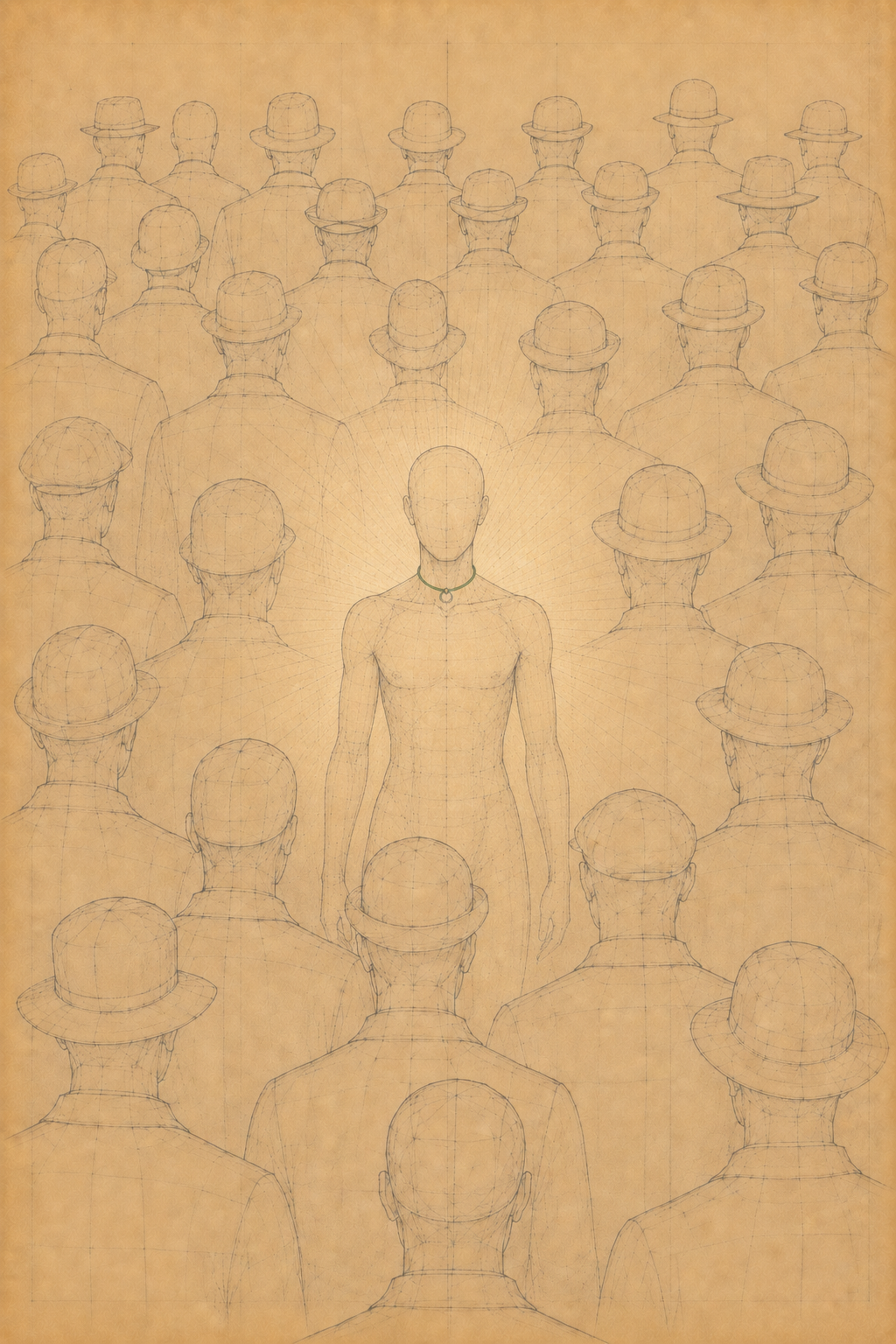
Hesse's question is not rhetorical. Most people who live a conscious D/s dynamic have asked it, in some form, more than once: all I wanted was to be myself — why was that so difficult? Not difficult because the dynamic itself is hard to hold. Difficult because the world surrounding it has, often without any intention of cruelty, decided in advance what a relationship is supposed to look like, and anything outside that template gets quietly filed as a problem, an eccentricity, or a phase.
This is what Vanilla looks like from the inside of a relationship that has stepped past it: not an enemy, not a lesser way of living, simply the world most people around you are still standing in, often unaware there's anything else to stand in. The question this pattern asks is not how to convert that world or defend against it, but how to move through it with dignity intact — what gets carried across the threshold, dressed differently, and what stays entirely inside the container where it was built.
This is exactly where Extraordinary Protection becomes visible in its most concrete form. A world that doesn't understand a dynamic will, without necessarily meaning harm, find ways to make a submissive small — to question, doubt, or quietly undermine what they've built, simply by failing to recognise it as real. Part of what a dominant carries here is standing between that misunderstanding and the person they're responsible for, so the submissive can remain fully in their power rather than shrinking to fit a world that hasn't made room for them.
Dr. Bob Rubel writes about this directly in his work on protocol and Master/slave relationships: that a dynamic's relationship to the outside world is not a footnote to the dynamic but one of its real, ongoing tests. How a household manages disclosure, how it answers an awkward question at a family gathering, how it decides what a sibling or a close friend is eventually told — these are not separate from the M/s relationship. They are part of how it is lived. This is, in practice, an extension of The Contract and Non-Negotiables into territory neither pattern fully covers on its own.
The Nature of Your Relationship is what's actually being protected here. Not secrecy for its own sake, but the integrity of something that depends, in part, on not being subjected to outside judgment before it's ready to withstand it — or before the people in it have decided it needs to.
Possible Pathways
Decide, deliberately and together, what crosses the threshold and what doesn't — before the moment arrives where it has to be decided on the spot, in front of someone. This is Negotiations applied outward instead of inward.
Find the dynamic's day collar for the outside world — some visible, legible version of what's underneath, worn in a register the wider world can actually read. A particular kind of attentiveness. A small object. A way of speaking to each other that says everything to the two of you and nothing in particular to anyone else.
Hold the dynamic's Protocol Gradient consciously across this threshold too — not abandoned at the door, just turned down, the way a voice lowers in a library without going silent.
Let Daily Consent Basics govern this too: either person can ask, at any point, for more privacy or for more openness with a given person or situation. This is not static. It moves as the relationship, and the people around it, grow.
Discussion
Rubel's writing on protocol is useful here precisely because protocol, in his account, was never meant to stop at the front door of the household. It's a structure for living, and a couple or a family who has built one has to decide, consciously, how much of it travels — and in what form — when the people around the table don't share the same frame of reference. He treats this not as an inconvenience to be managed quietly, but as one of the genuine skills of a mature M/s relationship: the capacity to carry a dynamic with integrity through rooms that were never built to hold it.
The seam where the nameless quality lives
There is a particular kind of intimacy in standing at a family dinner, performing an ordinary conversation about ordinary things, while knowing — and watching your partner know — something the rest of the table has no access to. Yes Sir and What Would Master Do don't disappear at the threshold of a family home. They simply go quiet, operating underneath an ordinary surface, visible only to the two people who know to look for them. This is one of the more unexpected places The Nameless Quality shows up — not in the depth of a session, but in the seamless coordination of two people moving through a world that doesn't know what it's looking at, each fully aware of what the other is carrying, neither needing to say so.
The dynamic is not paused
Life as a Ceremony matters enormously here, because the easy mistake is to treat the outside world as an interruption — a pause button pressed on the way out the door, unpressed on the way back in. Lived that way, the dynamic becomes something that only exists in private, which quietly teaches both people that it isn't quite real the rest of the time. Held as ceremony instead, the dynamic doesn't pause at all. It simply changes register — the same devotion, the same attention, worn in a form the room in front of you can hold.
When the threshold is crossed without permission
Sometimes a comment is overheard, an object is found, a question is asked too directly to deflect. Direct Communications and Honesty govern what happens next between the people in the dynamic — but toward the person outside it, the dynamic gets to decide, deliberately, how much explanation it actually owes. Not everyone who glimpses something is owed the whole architecture behind it. Some doors can be closed gently, without lying, simply by deciding this isn't the room being offered today. And where it isn't closed — where someone close is told, and meets it with the kind of rejection Hesse's question quietly mourns — that grief belongs to the dynamic too, and deserves to be held inside it rather than carried alone.
[ Personal anecdote or teaching, to be added later. ]
Connected Patterns
This pattern extends The Contract and Non-Negotiables outward, and stands in direct relation to Vanilla — the world most of this pattern is actually about. Most directly, it gives concrete form to Extraordinary Protection — this is precisely where that protection is needed and exercised. It draws on Negotiations, Daily Consent Basics, and A Gradient of Protocols to decide what crosses the threshold and how. The Collar offers one shape for what gets carried into the outside world. Yes Sir and What Would Master Do continue operating quietly underneath it. The Nature of Your Relationship is what's being protected, Life as a Ceremony is what keeps it alive rather than paused, and Direct Communications and Honesty govern what happens when the threshold is crossed without consent. It sits beside Outside Friendships and Engaging Others, and reveals, unexpectedly, one of the quieter homes of The Nameless Quality.
"I wanted only to try to live in accord with the promptings which came from my true self. Why was that so very difficult?" — Hermann Hesse, Demian (1919).