
Engaging Others.
Context
This pattern closes the Boundaries layer. Where Relations with Family and Friends and Outside Friendships address the specific people already in a life, this pattern is about everyone else — the wider world a dynamic moves through every single day. Other practitioners. People newly curious about this path. People with no relationship to kink at all. Every one of them is met, however briefly, by what this dynamic has become.
It connects directly to Conscious Kink — because how a dynamic engages the world is itself part of what makes the practice conscious.
Core Dynamic
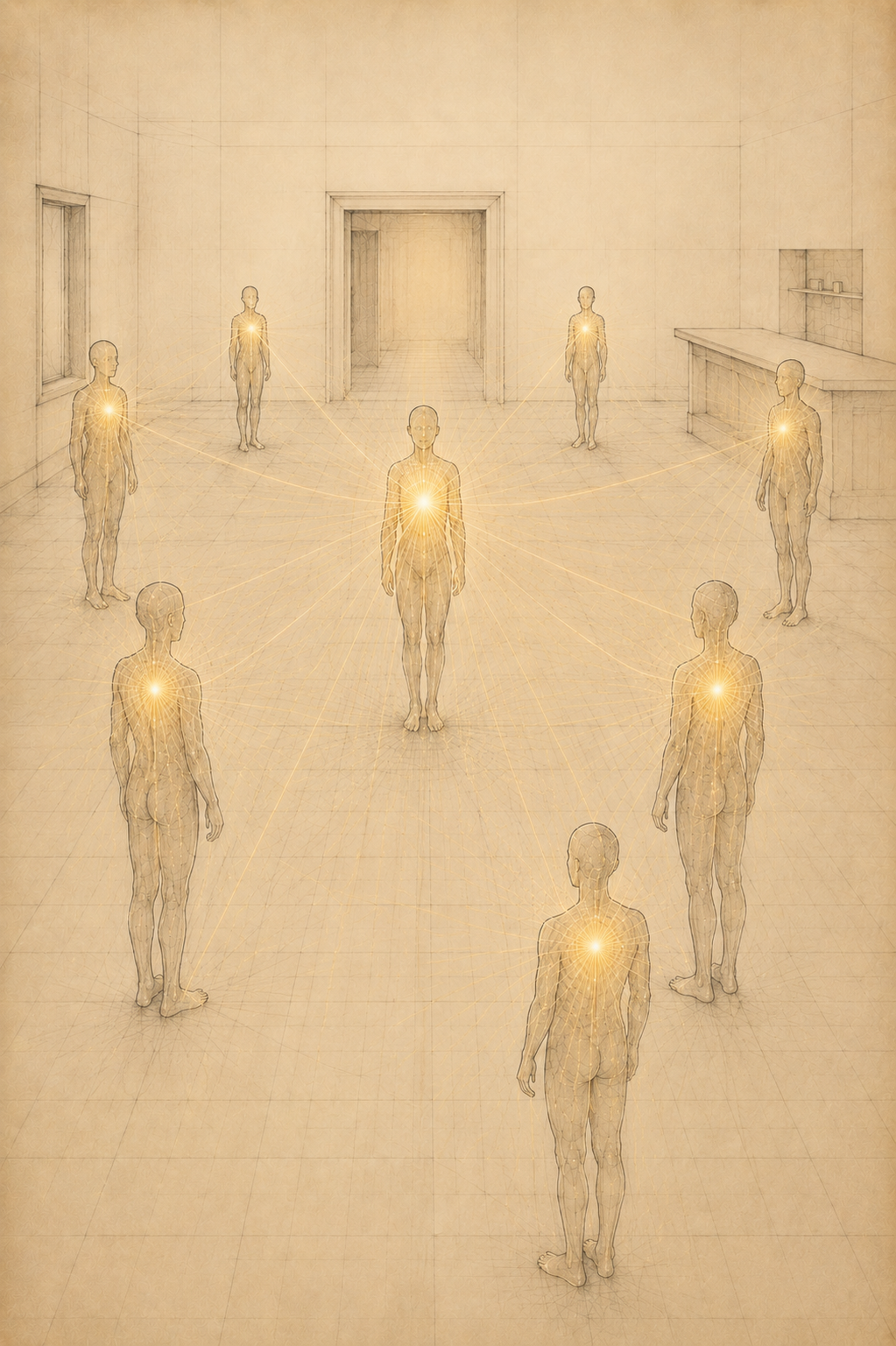
Thich Nhat Hanh's inter-being is not a metaphor here — it's the most literal possible description of what this pattern asks. The dynamic does not pause at the front door. The surrender, the groundedness, the awareness of the structure being chosen, all of it travels — into the supermarket queue, into a conversation with a stranger, into an ordinary Tuesday with nothing dramatic happening at all. The question this pattern asks is simple and enormous: how present are you, in your own chosen dynamic, while doing absolutely nothing remarkable?
This is not vigilance. It's not performance, and it's not something that needs to be managed or hidden out of caution. It is, instead, the natural overflow of a container built well enough — through Why Would You, through The Nature of Your Relationship — that it has room to spill outward. A dynamic that has actually given someone growth, potential, a deeper relationship to their own power or their own surrender, doesn't need to ration that gift to the moments labelled "scene." It simply becomes how that person moves.
Met this way, the world divides into three kinds of encounter, each its own small invitation. Other practitioners — people walking some version of this same path — are met with recognition rather than comparison: a different shape of the same courage, never a competition. People newly curious about this practice are met with the generosity this dynamic was itself shown, or wished it had been shown, at the very beginning — because what gets modelled to someone arriving is what they'll carry forward. And vanillas, people with no relationship to any of this and no need for one, are met with the same calm pride a collar can be worn with: nothing hidden out of shame, nothing pushed forward uninvited, simply a person standing fully in what they've chosen.
Yes Sir and What Would Master Do are, in the end, exactly this pattern in miniature: an orientation so fully internalised that it doesn't need the scene to express itself. It simply moves through the world as the person now does.
Possible Pathways
Let groundedness be the thing that travels, not caution. Notice, in an entirely ordinary moment — paying for groceries, waiting for a bus — whether the dynamic you've chosen is present in how you stand, how you meet someone's eyes, how unhurried you allow yourself to be.
Meet other practitioners as companions on a related path, not as a hierarchy to climb or a community to perform for. Meet anyone newer to this than you with the generosity you most wanted at your own beginning.
Carry what this dynamic has given you into the world with the same quiet pride described in The Collar — nothing concealed for shame, nothing announced for effect, simply present, simply yours.
Discussion
There's a particular kind of magic in this pattern that's easy to miss precisely because it looks so unremarkable. The deepest evidence that a dynamic is real isn't found in its most intense scenes — it's found in the supermarket, in the waiting room, in the hundred small ordinary minutes of a day where nothing about the dynamic is visible to anyone watching, and yet everything about it is quietly, fully there. Life as a Ceremony and Sacredness live here as much as anywhere else in this language — perhaps more, because there's no scene to lend the moment weight. The weight has to come from somewhere else: from how thoroughly the dynamic has become part of how a person simply is.
Recognition among practitioners
There's something genuinely moving about encountering another practitioner — someone holding a dynamic shaped completely differently from your own — and recognising, underneath the difference, the same fundamental courage: the choice to build something deliberately rather than inherit it. This recognition doesn't require agreement about method. It only requires seeing the shared root.
What gets passed forward
Most of what anyone knows about walking this path was given to them by someone who walked it earlier — a conversation, a piece of writing, a moment of unexpected generosity from someone who had no obligation to offer it. That chain only continues if it keeps being passed forward. Meeting someone newer to this path with genuine warmth, real answers, and no need to perform seniority is one of the more direct ways Conscious Kink becomes visible in practice rather than just in theory.
Standing fully in front of the world
Most people a practitioner meets day to day have no relationship to any of this, and don't need one. That's simply true, and it asks for nothing more complicated than ordinary discretion — the same discretion anyone extends to any part of their life that isn't everyone's business. What it doesn't ask for is shrinking. A person who has done the work described across this entire language — who has met their shadow, built real agreements, found genuine surrender or genuine dominance — carries something the world rarely sees fully embodied: a person at ease with their own power, whichever direction it flows. That ease is its own quiet offering to everyone they meet, whether or not anyone ever knows why.
[ Personal anecdote or teaching, to be added later. ]
Connected Patterns
This pattern closes the Boundaries layer alongside Relations with Family and Friends and Outside Friendships, and connects most directly to Conscious Kink. It rests on Why Would You and The Nature of Your Relationship, and on the groundedness built through Meeting the Shadow, Dominance, and Surrender. The Collar offers its model of quiet pride, and Yes Sir and What Would Master Do describe the same internalised orientation at a smaller scale. Life as a Ceremony and Sacredness are what allow this pattern's most ordinary moments to carry its deepest weight.
"You are me, and I am you. Isn't it obvious that we inter-are?" — Thich Nhat Hanh, "Interrelationship," from Call Me by My True Names: The Collected Poems of Thich Nhat Hanh (Parallax Press, 2005).