
Outside Friendships.
Context
Where Relations with Family and Friends addresses the people who knew you before this dynamic existed, this pattern is about something slightly different: the friendships — old or new, inside the wider conscious kink world or entirely outside it — that exist independently of the dynamic, chosen rather than inherited, and that represent each person's continuing life as someone other than a role.
It connects closely to Vanilla — the protocol-free space this pattern's friendships often live inside — and to Engaging Others, which follows it.
Core Dynamic
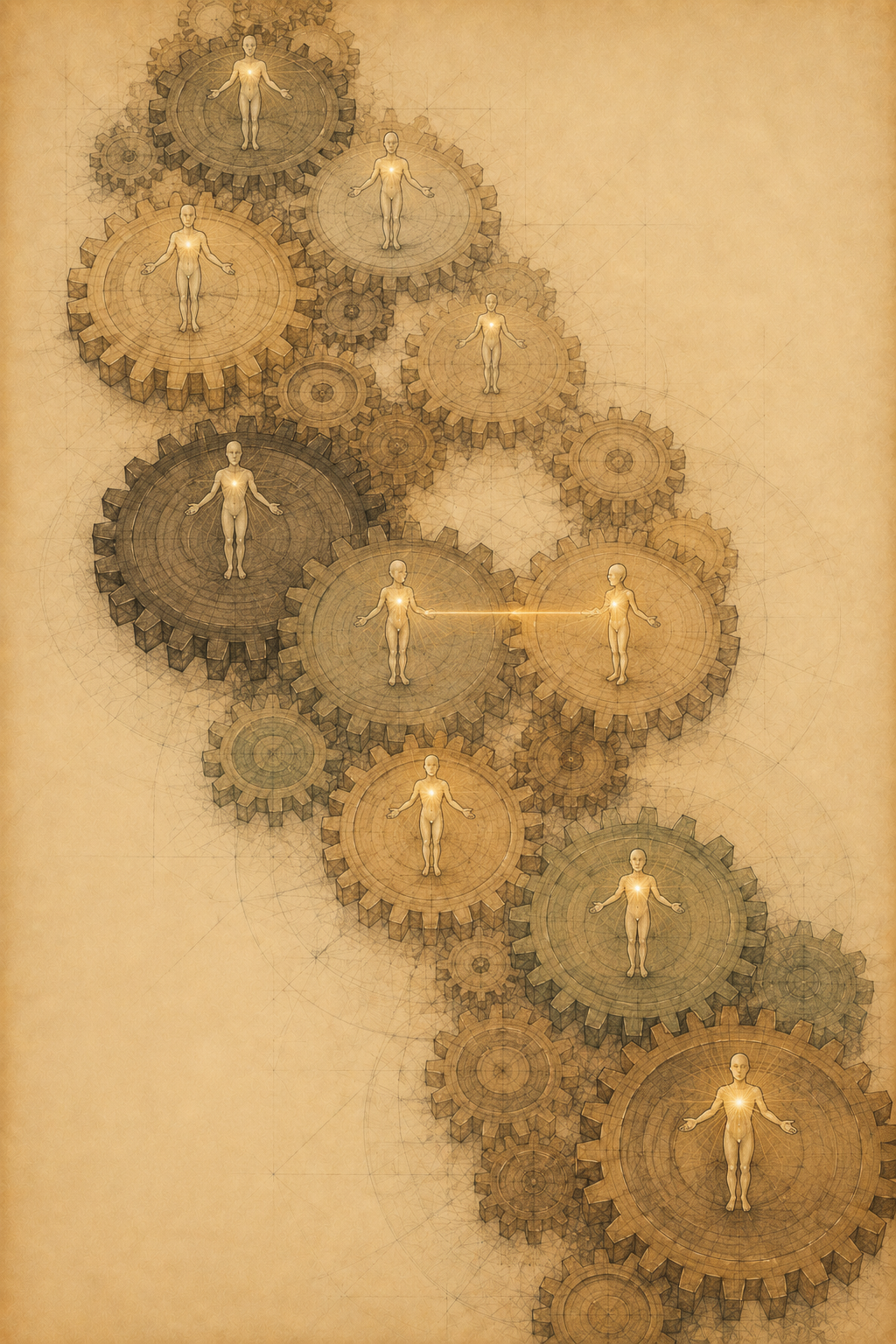
This pattern is not about devotion, and it is not a safety checklist. Whether someone has many friendships outside the dynamic or very few says nothing, on its own, about how devoted they are or how healthy the dynamic is. What this pattern is actually about is something Gibran names precisely: spaces in the togetherness. Not absences. Spaces — deliberately held, valued for what they are, not tolerated as a concession.
A friendship outside the dynamic does something the dynamic itself, by its very nature, cannot: it relates to a person as a whole person, outside any role. The friend who has known you for fifteen years, who teases you the way only an old friend can, who has no idea what a protocol gradient is and doesn't need to — that friend is in contact with a version of you that the dynamic was never built to see. This is not a gap in the dynamic. It is part of what keeps the dynamic — and the person — whole.
This connects directly to Why Would You and The Nature of Your Relationship. A person with a full life outside the dynamic who continues, freely, to choose it, is making that choice from a position of genuine agency — not because there is nothing else, but because this, specifically, is wanted. That distinction matters enormously, and a dynamic that actively values and encourages outside friendship is, in effect, choosing to keep being chosen, again and again, rather than simply being the only option left standing.
What this pattern asks for, concretely, belongs in Needs, Wants, and Non-Negotiables, written into The Contract as explicitly as anything else that matters: not as a grudging allowance, but as something actively named, valued, and protected.
Possible Pathways
Name outside friendships explicitly as something the dynamic values, not merely permits. Ask, honestly, what a friendship offers that the dynamic itself doesn't — and let that be a reason to protect it, not a threat to manage.
Decide together, through Structured Agreements and the Protocol Gradient, how much of the dynamic travels into these friendships and how much stays behind. There's no single right answer — only the one this specific dynamic and these specific friendships actually call for.
If a day collar, or some other quiet marker, is carried into these spaces, let it be carried with the same pride described in The Collar — even where the world meeting it carries its own assumptions about power, ownership, or what a relationship is supposed to look like.
Discussion
Lee Harrington's writing on sacred kink returns often to the idea that a person practising consciously is still, first, a whole person — and that wholeness is sustained by more than the dynamic alone. A friendship that has nothing to do with D/s, that simply enjoys you, is not a distraction from the sacred work of the dynamic. It is part of what keeps a person able to bring their full self into that work in the first place.
Why outside perspective keeps a system healthy
Douglas Thomas's psychological work on BDSM offers a useful, less moralised way to think about this than the language of devotion: any close system — a couple, a household, a dynamic — tends to drift over time without contact with perspectives from outside it. This isn't a comment on anyone's character. It's closer to systems theory than ethics. Outside friendships act as a kind of external reference point: not there to police the dynamic, simply there, living their own lives, offering an unintentional, ongoing reminder of how the wider world looks and feels. A dynamic that has that reference point available tends to stay more flexible and self-aware than one that doesn't — not because isolation is shameful, but because feedback from outside a system is one of the things that keeps any system oriented.
Carrying it into a world with its own opinions
The world outside the dynamic is not neutral about power-imbalanced relationships. Friendships, even warm and well-meaning ones, can carry assumptions — about who has the power, who is at risk, what a relationship built this way must really mean. Extraordinary Protection extends naturally into this territory: part of what a dominant carries is helping a submissive move through these friendships without needing to constantly defend what they've chosen. Yes Sir and What Would Master Do operate here too, quietly — the orientation that lets someone move through a friendship that doesn't fully understand the dynamic with steadiness rather than apology.
A structural foundation, lightly worn
Rubel and Fegatofi both write, in their own ways, about how much of a healthy long-term M/s structure depends on agreements made explicit rather than assumed. Outside friendships are exactly this kind of territory: better named clearly in advance — what's shared, what isn't, how much protocol travels — than left to be improvised, person by person, in the middle of someone else's dinner party. Done well, this groundwork is rarely visible. It simply means that when a friendship and the dynamic meet, as they inevitably will, the dynamic has already decided how to hold that meeting — with Life as a Ceremony and Sacredness intact, rather than scrambled together on the spot.
[ Personal anecdote or teaching, to be added later. ]
Connected Patterns
This pattern is grounded in Why Would You and The Nature of Your Relationship — what continuing to choose the dynamic, freely, actually rests on. It draws on Needs, Wants, and Non-Negotiables, held inside The Contract through Structured Agreements and the Protocol Gradient. It is closely related to Vanilla, and depends on Extraordinary Protection, Yes Sir, and What Would Master Do for how the dynamic is carried into spaces that may not understand it. The Collar offers one shape this carrying can take, and Life as a Ceremony and Sacredness are what keep it intact while doing so. It sits beside Relations with Family and Friends and Engaging Others.
"Let there be spaces in your togetherness, and let the winds of the heavens dance between you... And stand together, yet not too near together: for the pillars of the temple stand apart, and the oak tree and the cypress grow not in each other's shadow." — Kahlil Gibran, The Prophet (1923), "On Marriage."