
Vanilla.
Context
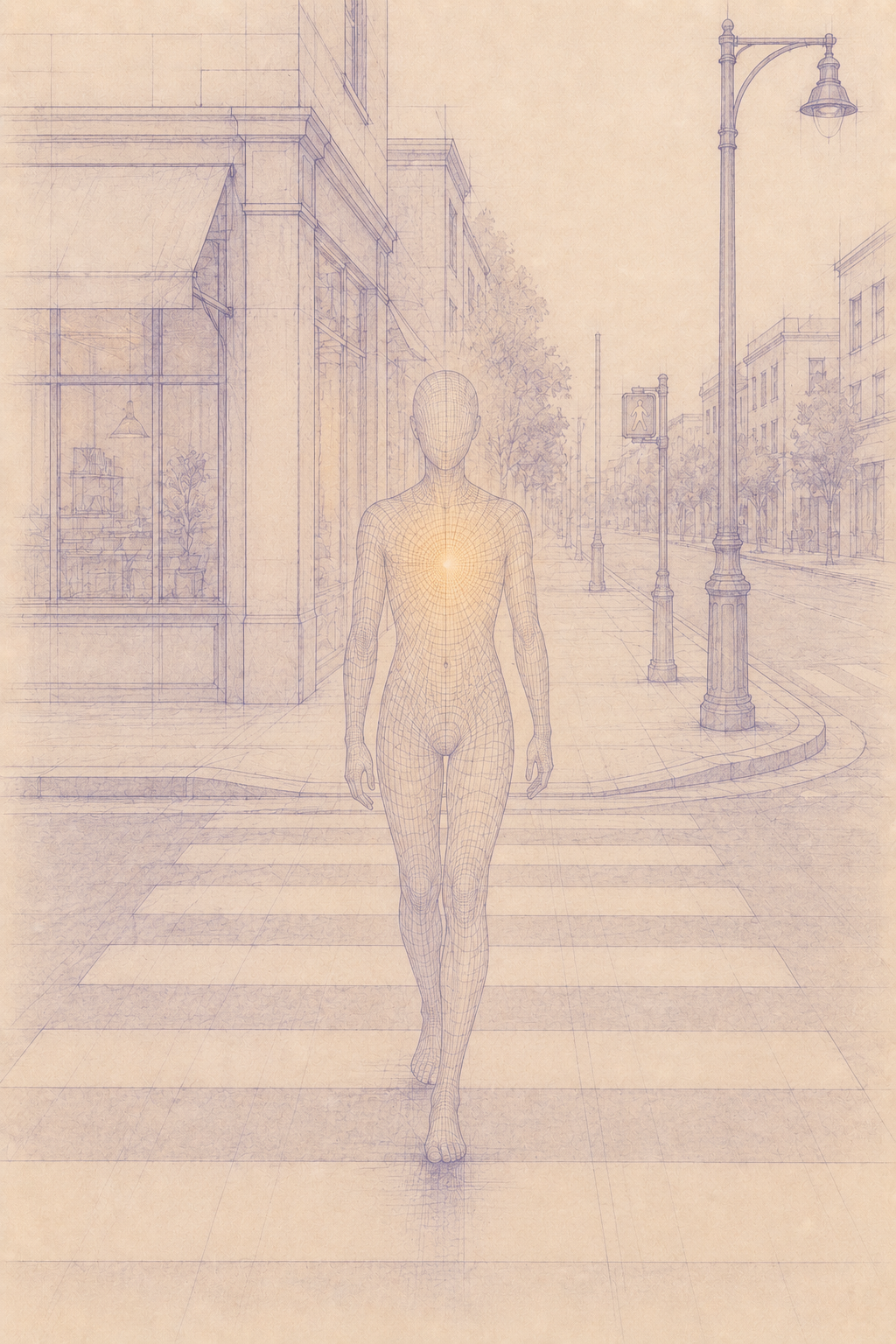
This pattern addresses the touching of worlds. Whether someone has been a kinkster all their life or came to that recognition later, there is a general outside world, where supermarkets, hospitals, and pedestrian crossings are found, and an inside world that can be coloured any way one likes. We need to recognise that we will need to visit the general world, and function in it. Shopping must be done, streets must be crossed, sometimes. In general, anything not directly related to kink is considered Vanilla.
This pattern is a key component of Why Would You and The Nature of Your Relationship. It relates to the shadow in a particular way, because it deals with both — one's own shadow, which might be worked upon within the chosen dynamic, and the shadow of the general world, which may cast its judgemental projection onto that dynamic, or the people in it.
Core Dynamic
The challenge here is that none of this is rigid. What is Vanilla for one person carries enormous charge for another — a hospital visit might be entirely neutral, or, for someone with a medical fetish, quietly thrilling. The boundary isn't fixed. It's personal, and it moves.
The aim isn't separation. It's safety — within oneself, and within the world being moved through. In order not to let the dynamic someone has chosen to live in be overshadowed by what is, culturally, considered normal, there's room to embrace and expand on these themes: on one hand, practising real care in where and how exposure happens (and even more so, where it concerns others), and on the other, learning to marinate and relish in the simple knowing of one's own secret, true life.
This is not two personas held side by side. Growing Wholeness doesn't ask anyone to cultivate a Vanilla self and a true self and switch between them like outfits. It asks for one integrated whole, capable of choosing — consciously, by its own authority — to show less of itself in certain rooms. The Nameless Quality lives in exactly how seamless that integration is. The better it's built, the closer a person stays to themselves, in any room at all.
Possible Pathways
Notice where the personal boundary between Vanilla and not-Vanilla actually sits, since it won't match anyone else's. Practise discretion as care rather than as shame — particularly where it concerns others who haven't consented to visibility. And practise the opposite skill too: privately savouring the knowledge of a true life that doesn't need to be shown to be real.
When the Vanilla world judges — and it will, sometimes — learn to see the loop for what it is. The world that calls something shadow is very often pointing at its own unexamined darkness, projected outward and mistaken for evidence. Recognising that loop, and being able to leave what belongs to someone else where it belongs, rather than absorbing it as personal shame, is a necessary and genuinely health-giving skill.
Discussion
Living together
For couples who live together, the question has a particular texture: when do partners speak as partners rather than as dominant and submissive? Conflict resolution outside protocol matters here too — conflict inside a power-asymmetric structure, where one person's word carries structural authority, isn't the same as two people simply working something out together.
The wider world
Most D/s couples exist within a world that doesn't know what they are. In that world, they are usually Vanilla by necessity. The real question is whether this necessary Vanilla space curdles into resentment — the sense that the dynamic has to be hidden — or becomes simply another room in the house: unremarkable, useful, no less theirs for being quiet.
Connected Patterns
This pattern is connected to Structured Agreements, Protocol Gradient and Standing Orders. It is very much related to 'What Would Master Do'. It also connects to #59, #60 and #61, where contact with Others is shaped.
"Meditation is not something apart from life..." — Jiddu Krishnamurti, The Book of Life: Daily Meditations with Krishnamurti, compiled by Mary Lutyens (HarperOne, 1995).