
Bondage.
Context
Bondage is the practice of restricting the body's movement — through rope, tape, restraints, or position — as an instrument of presence, surrender, and connection. It is one of the oldest practices in the BDSM tradition, and one of the most misunderstood. The restriction is the path, not the point. What the restriction makes possible — the inward turn, the expansion of inner space, the dissolution of ordinary self-management — is what this pattern is about.
This pattern builds on the full consent architecture — Daily Consent Basics, Consent Theory and Philosophy, Safe Words, Safety Within the Scene — and requires Negotiations that are specific about what is and is not welcome. It leads into Aftercare, which the body always needs after sustained restriction.
Core Dynamic
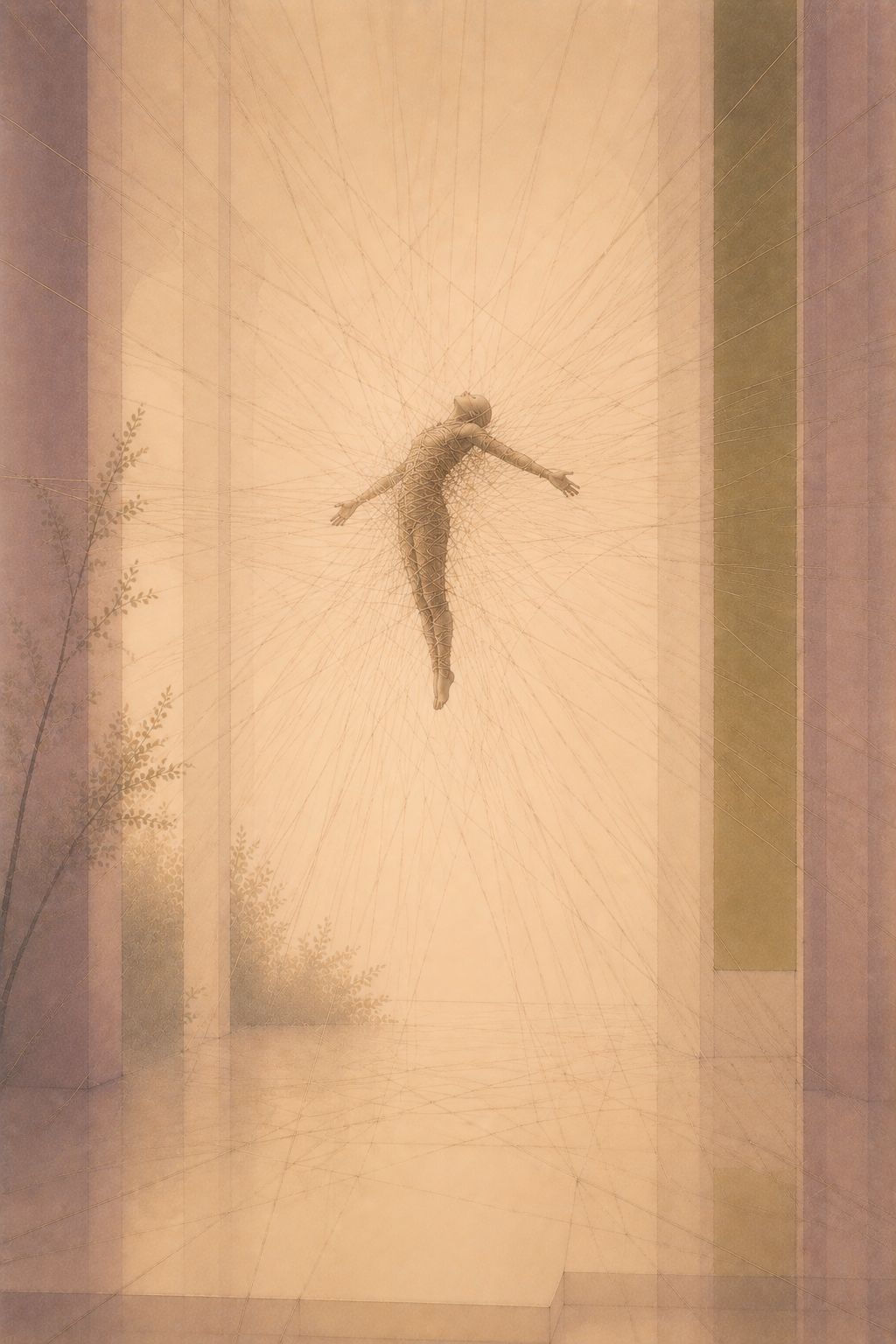
The paradox at the heart of bondage is that restriction produces expansion. The body that is bound has nowhere to go — and in that nowhere, something opens. The ordinary noise of self-management falls away. There is nothing to decide, nothing to arrange, nothing to protect. What remains is the body, the breath, the presence of the dominant, and the moment. The nervous system, deprived of its usual range of options, eventually releases into what is. That release is the gift of bondage at its best.
There are two primary directions in bondage, and they offer different paths to the same territory. The first is enclosing — the cocooning, wrapping, compressing forms that make the body small and held. Shibari at its most tender. The foetal position. The return to something oervertrouwd: the safety of the womb, the first container, the place where no danger could reach and no effort was required. The nervous system recognises this. Something very old in the body relaxes into being held. The ego, finding nothing to defend against, puts down its weapons.
The second direction is exposing — bondage that stretches, opens, holds the body wide and visible. No protection, no contraction possible. This is not comfort but courage: the sub spread open, unable to close, fully seen. The surrender here is of a different quality — not the warmth of being held but the vulnerability of being completely available, completely present, with no escape. Both paths are valid. Both require deep trust and explicit consent. And both, when done well, lead to the same inner territory: the place beyond self-management where genuine presence becomes possible.
Rupert Spira's witness-awareness is directly relevant here. The bound submissive who cannot move, cannot act, cannot manage their experience — that person is left with only awareness itself. The thoughts arise and there is nowhere for them to go. The sensations arrive and the body cannot escape them. What remains when the body's options are removed is the awareness that witnesses all of it. This is one of bondage's most profound gifts: it creates the conditions in which the sub can discover, directly and physically, that they are not their body, not their thoughts, not their fear — but the awareness that holds all of these.
The Jungian dimension is present too. The bound body is the ego in suspension — the ordinary organising self temporarily removed from its function. What surfaces in that suspension is not always comfortable. Shadows can arise that the movement of ordinary life keeps buried. The dominant who is present to this — who holds the space not only physically but psychologically — is doing something that goes well beyond rope work. They are holding a person in the territory where Meeting the Shadow can happen most directly.
Possible Pathways
Learn before you tie. Rope bondage in particular requires technical knowledge — nerve pathways, compression risks, positional hazards, time limits. The dominant who has not invested in this knowledge is not yet ready to bind another person. The investment is not only practical. It is an act of respect for what is being asked of the submissive.
Negotiate the direction before you begin. Enclosing or exposing? Cocooning or spreading? The sub who knows which direction speaks to something in them — and who can name it — gives the dominant something real to work with. And the dominant who asks, who is genuinely curious about what the sub is seeking, is already in the right relationship to the practice.
Stay present throughout. The dominant who has tied someone and then turns their attention elsewhere has made a serious error. The bound submissive is in an intensified state of vulnerability and trust. The quality of the dominant's attention during the binding is what determines whether this is a profound experience or merely a technical one. And design the Aftercare with the same care as the binding — the body needs time and warmth to return from where it has been.
Discussion
Shibari — the Japanese art of rope bondage — is the most developed tradition within this practice, and one of the most beautiful. Originally derived from hojojutsu, the martial art of restraining prisoners, it was transformed over centuries into an aesthetic and spiritual practice. The ropes in shibari are not merely functional. They are a conversation between two bodies — the dominant's hands moving through the submissive's body, the knots marking points of connection, the completed work a visible expression of the dynamic between the two people. Midori's work on shibari describes it precisely: the rope is not what binds. It is what connects.
The return to the womb
The cocooning forms of bondage — tight wrapping, foetal positioning, the body made small and held — access something very old in the human nervous system. The first safety any of us knew was enclosure: held, warm, fed, without the need to act or decide or protect. Many people who seek this kind of bondage describe something that is not erotic in the usual sense but profoundly restful — a return to a state of being that ordinary adult life makes almost completely unavailable. The body remembers. The nervous system, given permission to release into being held, returns to something it has always known.
Safety in bondage
The safety considerations of bondage are specific and non-negotiable. Nerve compression, circulatory restriction, positional hazards — each form of bondage has its own risk profile and its own required knowledge. Scissors or a safety cutter must always be within reach. Time limits matter. The dominant checks circulation regularly. And non-verbal safe signals — three taps, a held object that falls — are essential for scenes where the mouth is not available for words. These are not cautious additions to the practice. They are what make the depth possible. The container that is genuinely safe is the container that can hold genuine depth.
Midori, The Seductive Art of Japanese Bondage (2001). Lee Harrington, Sacred Kink (2009). Rupert Spira, The Nature of Consciousness. Douglas Thomas, The Deep Psychology of BDSM and Kink (Tantor Audio, 2024).
Connected Patterns
This pattern requires the full consent architecture — Daily Consent Basics, Consent Theory and Philosophy, Safe Words, Safety Within the Scene — as its living infrastructure. It builds on Negotiations — the direction and form of the bondage must be explicitly agreed. It connects to Sensory Experience — restriction intensifies all other sensation — and to Toys and Tools, of which rope and restraints are a primary category. It speaks to Surrender in its most physical form and to Dominance expressed through the hands and the craft of binding. It connects to Attending — the dominant who has bound someone must be fully present throughout — and to Meeting the Shadow, which the suspended ego makes more available. It speaks to The Underworld Journey — bondage is one of the most direct paths there — and to Tantra, the body as gateway. It leads into Aftercare — the body always needs care after sustained restriction. And it reaches toward The Nameless Quality — which can arrive in the stillness of a body that has nowhere left to go.