
Safety within the Scene.
Context
Safe Words gave the scene its instrument — the word that cuts through everything and means exactly what it says. This pattern is where that instrument is set inside its full architecture. Not the moment of stopping, but everything that makes stopping unnecessary most of the time, and survivable on the rare occasions it is needed.
This pattern closes the Practice layer. Everything built across The Scene, Aftercare, and Things that Matter converges here, before the language turns to Boundaries.
Core Dynamic
A scene that goes deep needs two things that pull in opposite directions. It needs structure strong enough that nothing essential can fall through — and it needs a submissive free enough from holding that structure that they can actually disappear into the depths the scene is offering. The tension is real. RACK — risk-aware consensual kink — names it directly: a submissive who must keep one hand on their own safety has, by definition, not fully let go. Something in them is still standing guard.
This pattern's answer is not to resolve that tension by pretending it doesn't exist. It's to relocate where the guarding happens. Needs and Wants, named honestly before anything begins, and Desired Expansion, mapped with care — these move the guarding out of the scene and into the preparation. Daily Consent Basics and Consent Theory and Philosophy build the floor the scene stands on. By the time the scene begins, the boundaries are not something the submissive holds in their own awareness — they are something the dominant carries, fully, on their behalf. That handover is what makes the deeper surrender possible. Not the absence of a limit, but the absence of needing to remember it yourself.
The Collar marks the threshold into this handover — the moment the dynamic, in session, begins. From that point, the structure carrying safety is no longer abstract. It is a person, fully present, fully responsible. This is what Yes Sir means in practice during a scene — your pleasure is my pleasure is not only an orientation toward instruction, it is the orientation that makes it safe to stop tracking your own edges, because someone else has taken on tracking them for you.
A scene held this way is never too small or too large to matter. Whatever has been negotiated — gentle or rough, brief or long, playful or profound — becomes, inside this architecture, a ceremony in session. Its depth is not measured by its intensity but by whether it was met with the attention Life as a Ceremony and Sacredness describe. Treated this way, every scene — however many or few patterns weave through it — carries the possibility of The Nameless Quality.
Possible Pathways
Do the guarding before the scene, not during it. Map needs, wants, and desired expansion in advance, with enough honesty that nothing essential is left for the scene itself to discover. The negotiation is where the net gets built. The scene is where it gets trusted.
As dominant, carry the boundaries as your own. Not as rules imposed from outside, but as a responsibility you have actively taken on — so fully that the submissive can feel, in their body, that they no longer have to. This is the weight Safe Words describes as your 200%.
Let the scale of the scene be whatever has been negotiated, and treat it as complete regardless. A short, playful scene held with full attention is not a lesser version of a long, intense one. Sacredness is not a function of duration or intensity. It is a function of attention.
Discussion
Toys and tools deserve a particular word here. A flogger, a rope, a blindfold, a cane — these are not neutral objects waiting to be used. Inside a held scene, Toys and Tools become attributes of something larger: a flogger is an instrument of power in the dominant's hand and, simultaneously, an invitation to surrender in what it does to the submissive's body. The object itself is inert. What it carries is everything this pattern is about — and that is exactly why it can only carry safely what the structure around it can hold.
The same is true, with more weight, for Bondage, Impact Play, and Roleplaying. Each of these intensifies the scene precisely by restricting one of the submissive's usual resources — movement, the ability to absorb without registering pain, the certainty of who is actually present in the room. That intensification is the point. It is also exactly why this pattern exists: the more a scene removes from the submissive's ordinary capacity to self-protect, the more completely that capacity has to have already been assumed by someone else, in advance, deliberately.
What moves through the mask
Douglas Thomas's Jungian reading of the scene applies with particular force here. In Roleplaying especially, archetypes move through the people wearing them — the Tyrant, the Innocent, the Punisher, the Child. This is not incidental to the scene's power; it is much of where the power comes from. But an archetype that is allowed to drive rather than to be worn is a different thing entirely. The Shadow can do extraordinary, healing work inside a held scene — and the same Shadow, unwatched, can quietly take the wheel. Part of what this pattern asks of the dominant is to stay aware enough of their own state to notice the difference: am I wielding this role, or has something in me started wielding me?
Katharsis and the net beneath it
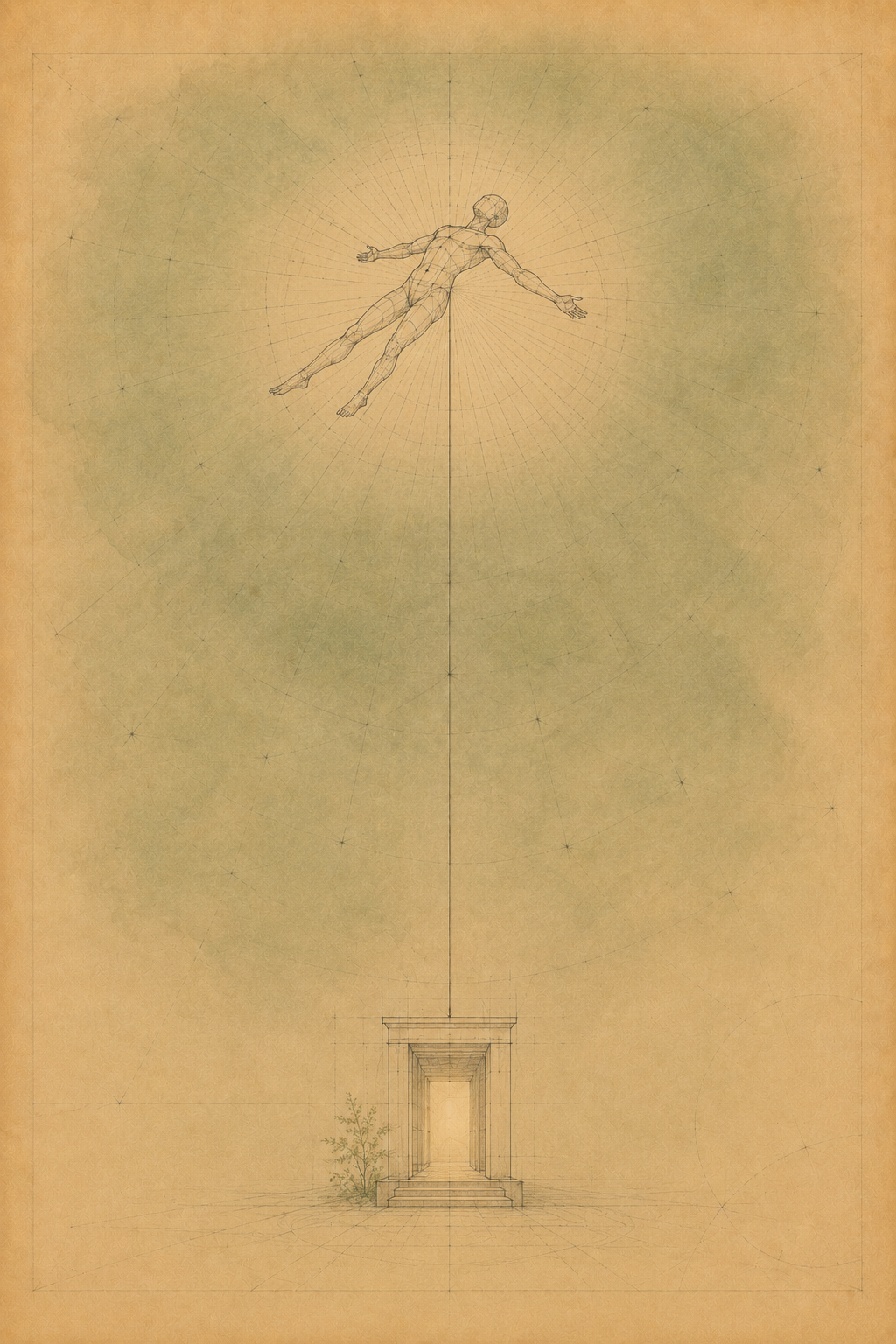
Katharsis — the release that some scenes produce, sometimes as tears, sometimes as laughter, sometimes as something that has no name — is only available to someone who is not, at the same time, monitoring their own edges. This is the clearest demonstration of why this pattern matters: katharsis and self-guarding cannot fully coexist. The net has to already be there, trusted, before the fall can become flight.
[ Personal anecdote or teaching, to be added later. ]
Connected Patterns
This pattern is built on Needs, Wants, and Desired Expansion — the map drawn before the territory is entered. It depends on Daily Consent Basics and Consent Theory and Philosophy, and is the architecture Safe Words already pointed toward as its own completion. The Collar marks its threshold, and Yes Sir describes the orientation that makes the handover of safety real rather than nominal. It connects directly to Toys and Tools, Bondage, Impact Play, and Roleplaying — the practices this safety makes possible — and to Katharsis, which depends on it entirely. It draws on Life as a Ceremony and Sacredness, and touches Jungian Archetypes and Meeting the Shadow — what can move through the scene, and what must still be watched. Together with The Scene and Aftercare, it completes the arc that makes The Nameless Quality possible.