
Roleplaying.
'There are no others.'
Context
Roleplay, ageplay, polarity play, pet play — all of these are forms of dynamic in which distinctive roles are inhabited. Depending on the depth and consciousness brought to the negotiations beforehand, what unfolds within these roles can range from playful exploration to the working through of trauma and the fulfilment of long-held desire. Roleplaying is a way of becoming more than one's usual self — even when that means becoming less: a thing, a possession, a pet. The role creates a doorway to a self that the ordinary day does not make room for.
This pattern connects to Toys and Tools and the full consent architecture — Daily Consent Basics, Consent Theory and Philosophy, Safe Words, Non-Negotiables. It leads toward Katharsis and Aftercare.
Core Dynamic
Every role asks for certain things to be present and certain things to be absent. The daddy dom and the brat. The puppy and their trainer. The figure in the role and the figure receiving it. Each role carries its own energy, its own vocabulary, its own posture — and creating that role well, with genuine commitment from both people, opens a way of being that does not exist outside it. This is Things that Matter applied to character: the props, the words, the energy that the role requires are not decoration. They are what makes the role real enough to enter.
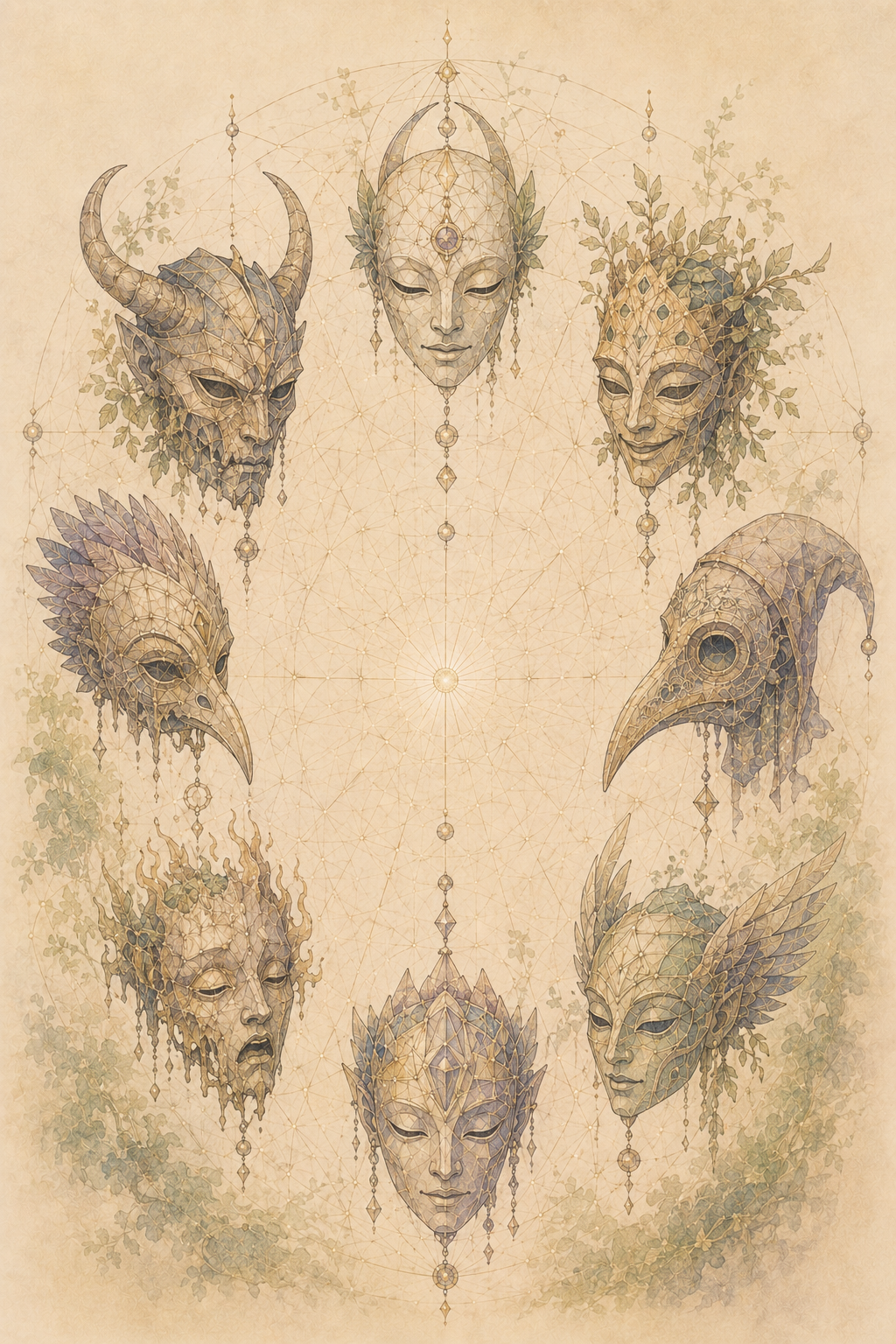
The roles that draw us most strongly are rarely arbitrary. The dynamic that calls to someone — the desire to be commanded, to be small, to be an object, to be worshipped, to be owned — points toward something in the psyche that the ordinary day does not have room for. Jungian Archetypes names this directly: the role is a mask that the unconscious puts on so that something can finally move. What lies beneath the role — what the role makes safe enough to approach — is often the actual material the dynamic is working with.
At its deepest, roleplaying touches non-duality. Sri Ramana Maharshi's teaching — there are no others — points toward a perspective in which Self and Other, dominant and submissive, the one who commands and the one who obeys, dissolve into a single field of action. Not my action for me, or your action for you, but our action for us — beyond the ego that ordinarily insists on the separation. This is consent taken to its furthest expression: not two people negotiating across a gap, but two people who have, for the duration of the play, become a single moving thing.
What lies beyond the veil that the role creates is the question this pattern keeps returning to. The role is not an escape from reality. It is a different angle of approach to it — a way of reaching what the ordinary self cannot reach directly. Roleplaying that stays at the surface — costume without commitment, words without energy — touches little. Roleplaying that is fully inhabited, where both people bring everything the role asks for, can become one of the most direct paths to Katharsis in this entire language — precisely because the role offered enough distance from the everyday self to let something real finally move.
Possible Pathways
Negotiate the role with the same care as any other practice. What does this role mean to each of you? What does it ask to be present, and what does it ask to be absent? Where are the non-negotiables that remain, no matter how deep the role goes? Name the entry and the exit — how does the role begin, and how is it left?
Ask what the role is reaching for. Not as an interrogation but as genuine curiosity — for yourself and for the other. What part of you wants to be expressed through this character that the rest of your life does not make room for? The answer does not need to be solved or explained. But knowing it deepens what becomes possible.
Bring everything the role asks for. Half-committed roleplay touches little. The energy, the props, the language, the posture — when these are fully present, the role becomes a genuine doorway rather than a costume. And design the Aftercare for the return — leaving a role that was deeply inhabited deserves the same care as leaving any other deep experience.
Discussion
Pet play, ageplay, and polarity play each open particular territory. Pet play allows a return to a state before language, before responsibility, before the weight of being an adult who must manage everything — a state of pure presence, pure response, pure being. Ageplay can open access to needs that were not met at the time they arose, offering a chance to receive now what could not be received then. Polarity play — the deliberate intensification of masculine and feminine, dominant and receptive — can restore an aliveness to roles that ordinary life has flattened into routine.
The role as veil and as lens
A role can function in two directions. As a veil, it conceals — it allows something to remain comfortably hidden, played at rather than met. As a lens, it focuses — it brings something into sharp enough view that it can finally be approached. The same role can function as either, depending on how fully it is entered and what is actually being avoided or sought. Part of the ongoing work of this pattern is noticing which is happening — not to judge it, but to know what is actually being asked for.
"God plays all of the parts — all the while pretending not to know who he is."
Alan Watts
"What is real? How do you define real? If you're talking about what you can feel, what you can smell, what you can taste and see, then real is simply electrical signals interpreted by your brain."
Morpheus
Connected Patterns
This pattern connects to Toys and Tools — props, costume, and instruments deepen the role. It requires the full consent architecture — Daily Consent Basics, Consent Theory and Philosophy, Safe Words, and Non-Negotiables — which remain in place regardless of how deep the role goes. It speaks to Jungian Archetypes — the role as the mask the unconscious wears to move freely — and to Meeting the Shadow. It connects to Things that Matter — the props and energy a role requires — and to Languaging, since each role carries its own vocabulary. It leads toward Katharsis and Aftercare. And it touches Tantra and The Nameless Quality — the role inhabited so fully that the distinction between Self and Other, actor and acted, dissolves.
Sri Ramana Maharshi, teachings on non-duality. Alan Watts, lectures on Hindu philosophy and the Upanishads. The Matrix (1999), written and directed by Lana and Lilly Wachowski. © Warner Bros. Alle rechten voorbehouden.