
Family Structure.
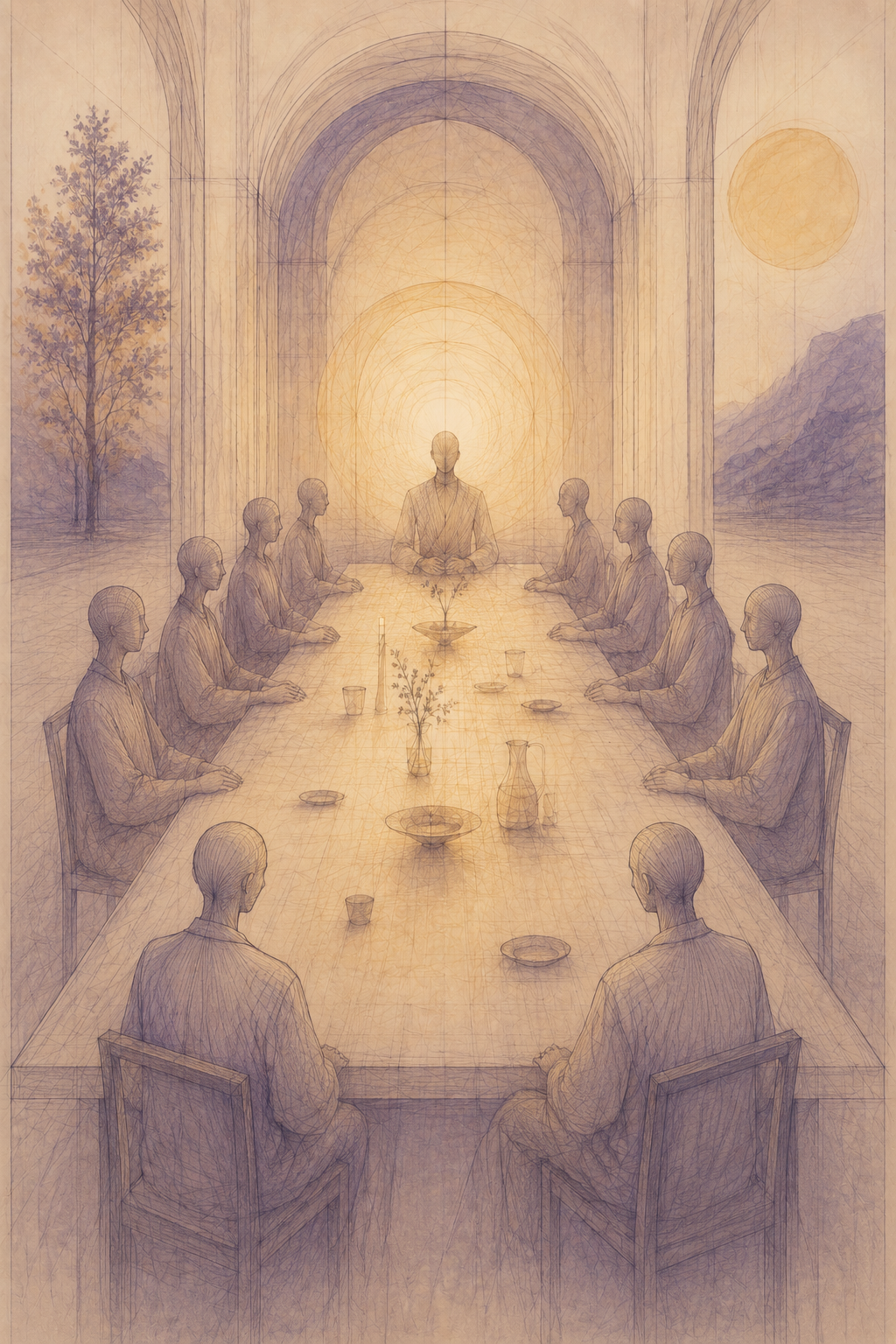
Context
This pattern addresses the relationship between the D/s dynamic and the wider family or household in which it lives. Children, co-parents, extended family, housemates — these people are not part of the dynamic, and yet the dynamic affects them. How it does so, and how consciously, is a structural question that requires an answer.
But this pattern reaches further than navigating the existing family. For households where the dynamic is not a private addition to ordinary life but the organising principle of the household itself — TPE, M/s, or a deeply lived D/s structure — it becomes the blueprint for a consciously designed family in the fullest sense. Not just a couple managing the gap between role and parenthood, but a household that knows what it is, names its bonds, and builds its structure with the same intention it brought to the dynamic itself.
Core Dynamic
Most guidance on D/s relationships is written as though the couple exists in a sealed container. In practice, most people live inside complex family and household arrangements — children from previous relationships, shared custody, ageing parents, chosen family, community commitments. The dynamic must find its place inside all of this, or it will eventually be displaced by it.
The central tension is between the internal logic of the dynamic — which has its own hierarchy, its own protocols, its own rhythm — and the external demands of family life, which frequently require both people to step outside their roles entirely. A dominant who is also a co-parent cannot be in role during a school pickup. A submissive who carries significant professional or parental responsibility in the outside world is not a different person when they enter the dynamic — they are the same person, with a different set of permissions activated.
Children require a specific kind of clarity. They should not be exposed to the power structure of the dynamic — not because the dynamic is shameful, but because a child's relationship with a parent needs to remain outside any adult hierarchy. The child who senses that one parent defers to another in all things learns something about power that they did not consent to learn.
This does not mean the dynamic must disappear when family life is present. It means the dynamic must be designed with family life in mind from the beginning — not retrofitted into it under pressure.
Possible Pathways
Map the family and household structure explicitly before designing the dynamic inside it. Identify the people whose lives intersect with yours — children, co-parents, family members — and the contexts in which the dynamic is active versus suspended. Design the transitions deliberately: how do you move between parental role and dynamic role, and what signals that transition to both of you?
Name the contexts in which the dynamic is not present, and treat those contexts as protected rather than as failures of the dynamic. And if the household itself is the dynamic — if this is a TPE or M/s structure designed from the ground up — then design the family the way you designed the relationship: with intention, with named bonds, with a structure that knows what it is.
Discussion
The question of children
People in D/s dynamics who are also parents tend to navigate this intuitively — stepping out of role when the children are present, maintaining the dynamic in the hours or spaces that family life leaves open. But intuitive navigation is not the same as designed navigation. The difference becomes apparent under pressure: when exhaustion, conflict, or external stress makes role maintenance difficult, and the question of which self to be in this moment has never been explicitly answered.
The household as designer family
To those who only play within the timebound settings of scenes, this pattern may be somewhat of a rarity. Yet for the household where the setting of the scene is daily life itself — and where the focus of the dynamic is a genuine shift in authority — this pattern can be of great importance. Why keep the magic small?
Here the concept of the designer relationship takes on the bigger scope of the designer family. Family is understood as a group of people who have a particular relationship with and to one another, and who choose names for those bonds — brother, sister being the obvious ones, but also protector, ropebunny, courtesan, property, slave, lover, owner. Whatever it is that creates a sense of bond and conveys something of the magic of that bond to those who are inside it.
The family structure of the household is hierarchical, with the Master of the house at the top — who might be welcoming and entertaining other Masters with their submissives or slaves. Rubel describes this world with characteristic precision, noting that within the M/s structure a Master can be different people to different people, expressing themselves differently across different relationships. Within the household there is also a hierarchy among submissives or slaves, with the Alpha Slave at the top of that branch. A Master might instruct a follower to take on a submissive of their own, in the light of their Growth, Power and Potential — all moving towards Growing Wholeness.
Rubel writes that the feel of a House is set by its key values, made real through its protocols — and that everything in the household should look effortless: Sprezzatura as the byword underlying all actions. The Nameless Quality pulsates in how organically all find their place in the family structure — Sprezzatura being a clear indicator of this happening. The consent layers and all the language layers are of vital importance here.
Chosen family and community
For people whose primary community is the kink world, the family structure question extends outward. A household that includes other dynamic participants — a poly structure, a house with multiple D/s relationships — requires its own internal architecture: who defers to whom in which contexts, what the hierarchy looks like when more than two people are present, how the structure accommodates the reality that not everyone's dynamic is compatible with everyone else's.
The outside world
Most D/s couples are often invisible to the world around them. Their families of origin, their colleagues, their neighbours often know nothing of the structure they live inside. This invisibility is usually chosen and usually functional. But it has a cost: the dynamic cannot be acknowledged in the contexts where it is most present. The dominant who cannot be recognised as such by the people who see them every day carries something unnamed. The submissive whose service is invisible to everyone outside the relationship may, over time, feel that it is invisible to themselves as well.
Designing the family structure means designing, at least in part, the question of who knows what — and what that knowing makes possible or impossible. The patterns around Relations with Family and Friends, Outside Friendships and Engaging Others address this external relational world in fuller detail.
Connected Patterns
This pattern is completed by the Alpha Slave, which names the hierarchy within the submissive branch of the household. Protocol Gradient governs the movement between roles that household life requires constantly. The patterns around Relations with Family and Friends, Outside Friendships and Engaging Others address where the household meets the outside world. Periodic Review keeps the structure honest as people and circumstances change.